
Every paid campaign lives or dies on its message. The same audience, the same budget and the same landing page can return wildly different results depending on which headline, value proposition or call to action you put in front of people. AI message testing is the practice of scoring those copy and CTA variants against a calibrated synthetic audience before any media spend, so you launch the winner instead of discovering it three weeks into a live test. This article is part of our wider guide on synthetic audiences vs A/B testing, and it focuses on the practical best practices for testing ad copy and CTAs with synthetic audiences[1]. The goal is simple: spend your impressions on messages that have already cleared a credible pre-test, not on finding out which of five headlines was a dud[2].
TL;DR
- AI message testing scores ad copy and CTA variants against a calibrated synthetic audience before launch, so weak messages are filtered out before they consume media budget.
- Live A/B tests on Meta and Google Ads typically need 50+ conversions per variant and 7 to 28 days to reach significance; a synthetic message pre-test returns ranked reactions in minutes.
- Calibrated synthetic audiences reach 80 to 95 percent agreement with historical research benchmarks on message-reaction tasks; generic LLM prompts collapse to around 55 percent panel parity.
- Best practice is to test one variable at a time (headline, value proposition, or CTA), use monadic and comparative formats, and segment results by audience.
- Synthetic pre-testing does not replace live A/B testing; it narrows the field so your live test only spends money on contenders that already passed.
What is AI message testing for ad copy?
AI message testing for ad copy is the process of evaluating headline, value-proposition and CTA variants against an AI-simulated audience calibrated to real consumer data, producing a ranking before the copy goes live. It answers “which message resonates?” in minutes rather than waiting for a live experiment to accumulate conversions. The output is a comparative score across clarity, relevance and persuasiveness, broken down by segment, so teams launch the strongest variant and reserve live budget for confirmation[3].
Crucially, the quality of that prediction depends almost entirely on what the synthetic audience is built from. An audience grounded in millions of real consumer profiles behaves very differently from a generic large language model asked to “pretend to be a 34-year-old marketer.” For a deeper look at how that grounding is measured, see our breakdown of benchmarking synthetic audience accuracy.
Why test ad copy with synthetic audiences before launch?
Testing ad copy with synthetic audiences before launch removes the biggest hidden cost of live experimentation: paying real media budget to learn that a message does not work. A live A/B test on Meta or Google Ads needs roughly 50 or more conversions per variant and a 7 to 28 day flight to reach significance, and every impression on the losing variant is wasted spend. A synthetic pre-test ranks the same variants in minutes[4].
The economics compound when you have many variants. Five headlines times three CTAs is fifteen combinations, and you cannot afford to run fifteen statistically powered live cells at once. Synthetic pre-testing lets you screen all fifteen, kill the bottom two-thirds, and take the remaining handful into a properly powered live test. This is the same logic agencies already apply to pre-testing ad creatives, extended from visuals to the words and the button.
How do you run a message test with a synthetic audience?
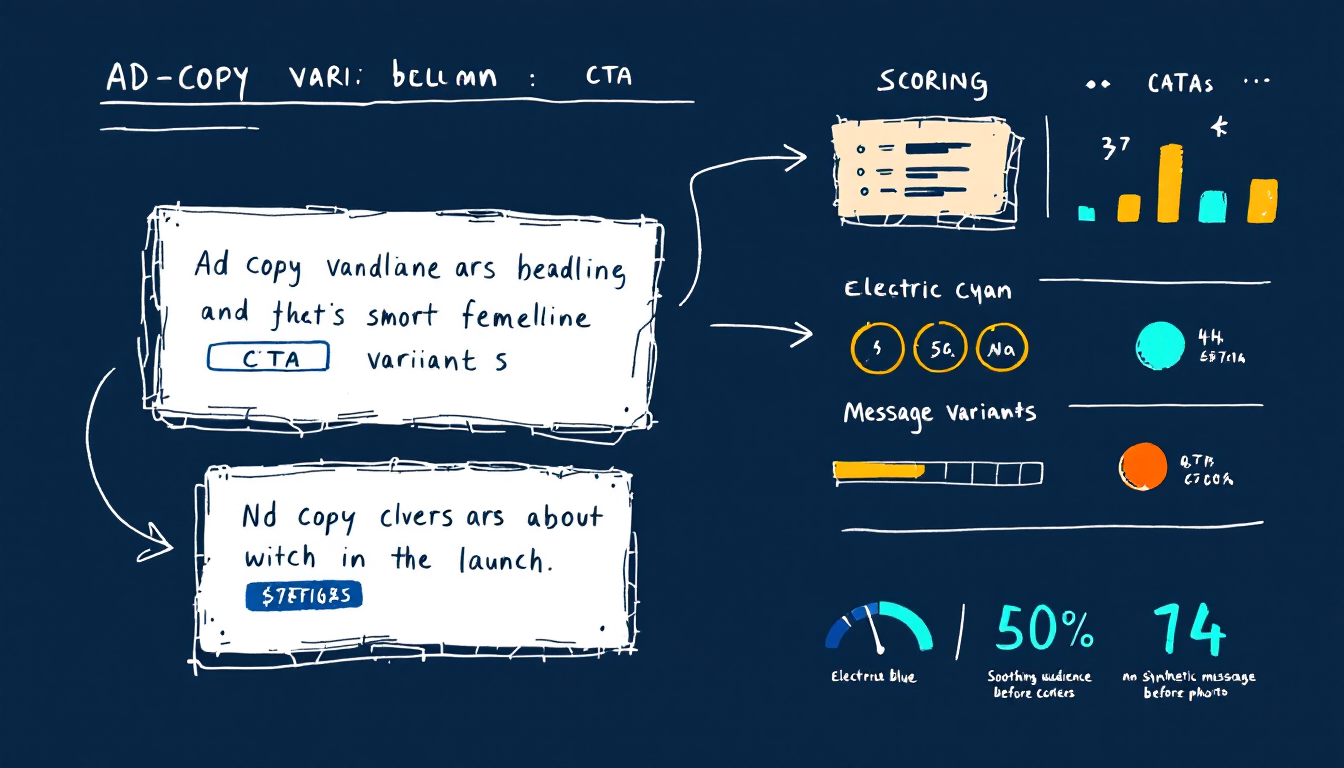
You run a message test with a synthetic audience in five steps: write the variants, brief the audience, score reactions, rank winners, and launch the top performers. Paste each headline, value proposition or CTA variant into a synthetic audience calibrated to your real customer base, collect predicted reactions across clarity and persuasion, then compare scores by segment before committing media spend. The whole loop typically takes minutes, not the days a live cell needs to accumulate data[5].
A disciplined workflow looks like this:
- Write the variants. Isolate one element per test: three headlines, or three CTAs, never both at once, so the result is attributable.
- Brief the synthetic audience. Define the segment (e.g. performance marketers, 28 to 45, B2B SaaS buyers) the same way you would scope a survey panel.
- Score reactions. Collect predicted reactions per variant across clarity, relevance and purchase intent.
- Rank winners. Compare scores within and across segments and flag where a message wins one audience but loses another.
- Launch the top performers into a live A/B test on Meta or Google Ads for final confirmation.

What are the best practices for testing CTAs with synthetic audiences?
The best practice for testing CTAs with synthetic audiences is to isolate the CTA as the single variable while holding the headline and body copy constant, then test each call to action in both comparative and monadic formats across every target segment. CTAs are uniquely segment-sensitive: “Start free” can outperform “Book a demo” for self-serve buyers and lose badly with enterprise procurement, so a single blended score hides the insight you actually need[6].
Five habits separate a useful CTA pre-test from a misleading one:
- One variable at a time. Change only the CTA. If you also change the headline, you cannot attribute the lift.
- Test the verb and the value. “Get the report” versus “See your score” is a value-framing test, not just a wording tweak.
- Always segment. Report CTA performance per audience, never as a single average.
- Pair message and destination. A CTA promise must match what the page delivers, which is why teams run this alongside landing-page optimization with synthetic audiences.
- Confirm, do not conclude. Treat the synthetic winner as a hypothesis to validate live, not a final verdict.
How accurate is synthetic message testing compared to live A/B tests?
Calibrated synthetic audiences reach roughly 80 to 95 percent agreement with historical research benchmarks on message-reaction tasks, while generic LLM prompts without real-data grounding fall to around 55 percent panel parity. The gap is not model size, it is calibration data. A synthetic pre-test is therefore highly reliable for ranking and screening variants, and a live test remains the gold standard for the final, money-on-the-line decision[7].
This is the central distinction the brand-positioning debate keeps missing. Generic prompts on ChatGPT or Copilot answer audience questions at around 55 percent parity; that gap is calibration data, not a smarter model, and it is exactly where a Digital Twin research layer sits, feeding those same agents grounded audience signals via API or MCP[8]. The table below frames the trade-off rather than declaring a winner.

| Dimension | Live A/B copy test | Synthetic message pre-test |
|---|---|---|
| Time to result | 7 to 28 days | Minutes |
| Cost | Real media spend on every variant | No media spend before launch |
| Sample size needed | 50+ conversions per variant | Not traffic-bound |
| Number of variants feasible | 2 to 4 in parallel | 10+ screened at once |
| Best role | Final confirmation | Screening and ranking |
Used together, the two methods compound: the pre-test cheaply narrows fifteen variants to three, and the live test spends real budget confirming the winner. For agencies tracking the downstream effect, our case studies on synthetic audiences and ad performance document how that screening step changes campaign economics, and AI pre-testing tools accuracy comparison covers how to vet vendor claims.
neuroflash Digital Twins: the audience research layer for your message testing
neuroflash is not a chatbot or an LLM access tool. Your stack already has Copilot, Claude, Langdock, or ChatGPT for that. neuroflash is the Digital Twin audience research layer those agents call for calibrated, human-grounded signals, via API or MCP. It scores ad-copy headlines, value propositions, and CTAs against real consumer profiles before a single impression is served.
- 1,000,000+ real consumer profiles as the calibration base, collected since 2017
- 85 to 95 percent predictive parity with real human survey panels (versus around 55 percent for generic LLM prompts)
- Results in minutes, not 4 to 8 weeks of traditional fieldwork
- API and MCP access, plug Digital Twins into ChatGPT, Claude, Copilot, Langdock, or any agent that speaks MCP
- Validated by 80+ academic studies, used by Fortune-500 brands for Decision Security
Rank every headline and CTA by segment in minutes, then take only validated contenders into your live Meta or Google Ads test. Start free.
When you need to validate that the segments themselves are sound before testing messages against them, pair this with validating AI audience segments and the channel-specific guidance in using AI synthetic audiences with Meta and Google Ads.

FAQ
What is the difference between AI message testing and live A/B testing?
AI message testing scores copy and CTA variants against a calibrated synthetic audience before any media is bought, returning a ranking in minutes. Live A/B testing serves the variants to real users on Meta or Google Ads and measures actual behaviour, which is more definitive but needs 50+ conversions per variant and a 7 to 28 day flight. They are complementary: the synthetic test screens and ranks, the live test confirms the winner with real money on the line.
How many ad copy variants can I test with a synthetic audience?
There is no traffic-based ceiling, so you can realistically screen 10 or more variants in a single synthetic pre-test, compared with the 2 to 4 cells a live A/B test can power at once. The practical limit is interpretability, not sample size: keep each test focused on one variable (headline, value proposition, or CTA) so the ranking stays attributable. Most teams screen a wide set synthetically, then carry the top three to four into a live confirmation test.
Can synthetic audiences test calls to action specifically?
Yes. CTAs are one of the strongest use cases because they are short, segment-sensitive and easy to isolate as a single variable. Hold the headline and body constant, vary only the call to action, and compare predicted click and intent scores per segment. Because a CTA that wins self-serve buyers can lose enterprise buyers, always report CTA results by audience rather than as a blended average.
Are synthetic message-testing results accurate enough to trust?
Calibrated synthetic audiences reach roughly 80 to 95 percent agreement with historical research benchmarks on message-reaction tasks, which is reliable enough for screening and ranking decisions. The accuracy depends heavily on calibration: audiences grounded in real consumer data far outperform generic LLM prompts, which sit near 55 percent parity. Treat strong synthetic results as a high-confidence hypothesis, then confirm the final choice with a live test.
Do I still need live A/B testing if I pre-test messages with AI?
Yes. Synthetic pre-testing narrows the field cheaply and quickly, but a live A/B test remains the gold standard for the final decision because it measures real behaviour with real money. The most efficient workflow uses both: pre-test to eliminate weak variants before they consume budget, then run a properly powered live test on the surviving contenders to confirm the winner.
My Take
The teams that win at paid media in 2026 are not the ones with the cleverest copywriters, they are the ones who stop paying to discover bad messages. For years, the only way to know whether a headline or CTA worked was to spend real budget finding out, and most of that spend bought losing variants. Synthetic message testing inverts that: discovery moves to a pre-test that costs minutes, and live budget is reserved for confirmation. The mistake I see most often is treating the synthetic score as the final answer. It is not. It is the screening round that earns a variant the right to a live test. Used that way, with one variable at a time, segment-level reporting and a calibrated audience underneath it, message testing stops being a guessing game and becomes a filter. The words and the button are usually the cheapest things to change and the most expensive to get wrong, which is exactly why they are worth pre-testing first.
References
- Minds (2026): “AI Message Testing Tools in 2026.” https://getminds.ai/blog/ai-message-testing-tools-2026
- Minds (2026): “AI Ad Creative Testing Tools in 2026.” https://getminds.ai/blog/ai-ad-creative-testing-tools-2026
- SightsAI (2026): “Synthetic Audience for Message Testing and Generation.” https://sightsai.co/
- HubSpot (2025): “How to Determine Your A/B Testing Sample Size and Time Frame.” https://blog.hubspot.com/marketing/email-a-b-test-sample-size-testing-time
- Influencers Time (2025): “Synthetic Data Ad Testing: Simulate Audience Reactions Fast.” https://www.influencers-time.com/synthetic-data-revolutionizing-ad-testing-with-simulated-reactions/
- Count (2026): “Ad Copy Testing: A/B Test Methods and Benchmarks.” https://count.co/metric/ad-copy-testing-analysis
- Trade Press Services (2026): “Synthetic Audiences: What They Are and How They Are Transforming Market Research.” https://www.tradepressservices.com/synthetic-audiences/
- arXiv (2026): “Large Language Models as Virtual Survey Respondents: Evaluating Sociodemographic Response Generation.” https://arxiv.org/html/2509.06337
- Nielsen Norman Group (2024): “A/B Testing 101.” https://www.nngroup.com/articles/ab-testing/
- Brainlabs (2026): “46 Meta Brand Lift Studies: Top Objectives and Creatives.” https://www.brainlabsdigital.com/meta-brand-lift-studies-objectives-creatives-results/
- C5i (2026): “Synthetic Audiences.” https://www.c5i.ai/synthetic-audiences/
- arXiv (2025): “AI-Augmented Surveys: Leveraging Large Language Models and Surveys for Opinion Prediction.” https://arxiv.org/html/2305.09620