
Most performance teams still discover whether an ad creative works the expensive way: they launch it, let Meta serve impressions, and read the verdict off a dashboard once the budget is half spent. Pre-testing ad creatives flips that order. Ad creative pre-testing is the practice of scoring your creative variants against a defined audience before launch, so you can predict which concept will win and kill the losers before they ever cost an impression. The most accurate way to do this today is with AI synthetic audiences: AI-modeled consumer panels, calibrated on real survey data, that simulate how a target segment reacts to each variant. This guide is a concrete, numbered workflow, and it sits within our wider series anchored by the pillar on synthetic audiences versus A/B testing.[1][2]
Key Takeaways
- Pre-testing ad creatives means scoring variants against a defined audience before launch, so weak concepts never reach paid impressions.
- Creative quality drives roughly 56 percent of the sales lift from digital advertising, which is why the creative is the single highest-leverage thing to validate first.[3]
- A five-step workflow, generate, build the audience, score, ship the winner, validate live, takes you from concept to a confident Meta launch in hours.
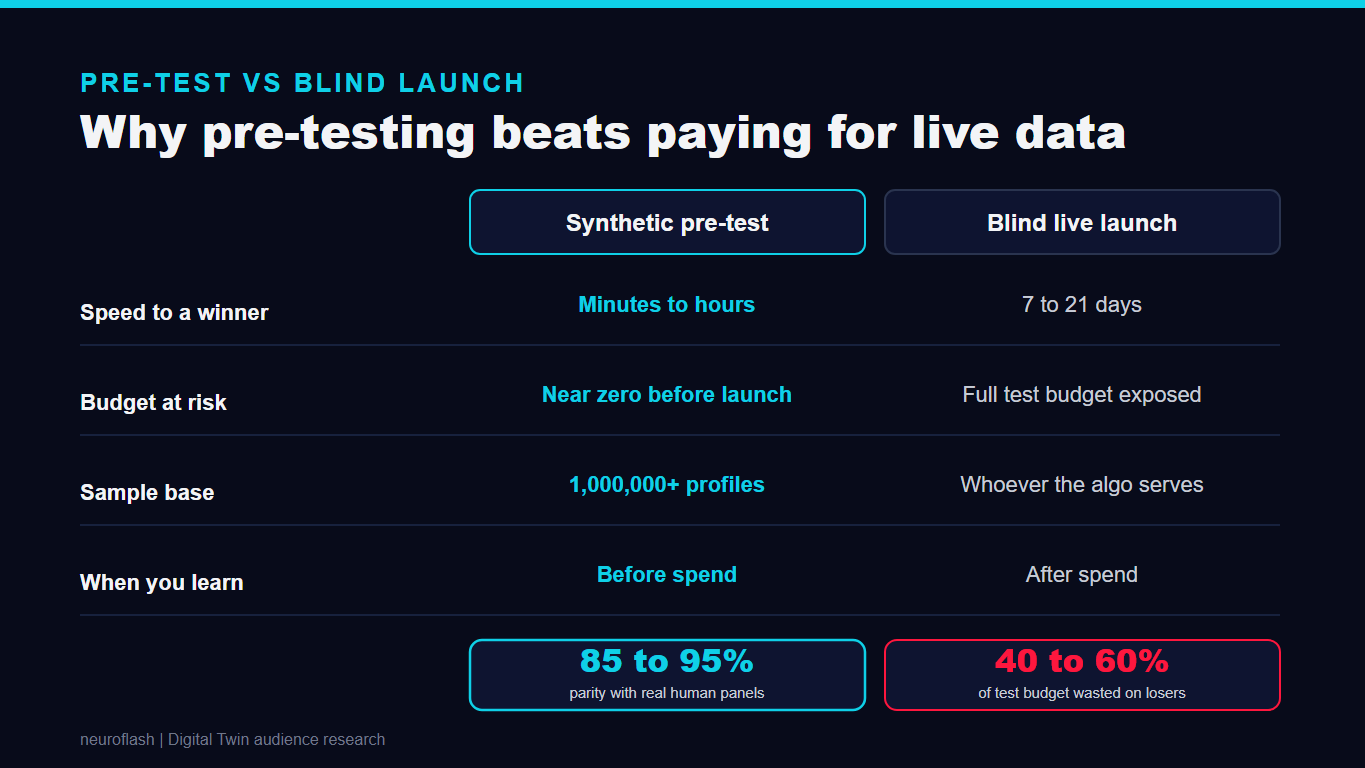
- AI-powered creative pre-testing has shown a 40 to 60 percent reduction in testing budget waste and cuts time-to-winner from 21 days to about seven.[4]
- neuroflash Digital Twins provide API and MCP access to 1,000,000+ calibrated consumer profiles with 85 to 95 percent predictive parity with real human panels.
What is ad creative pre-testing with AI synthetic audiences?
Ad creative pre-testing with AI synthetic audiences is a pre-launch method that scores creative variants against an AI-modeled consumer panel to predict performance before any media spend. Instead of paying Meta or Google to learn which ad works, you run two to five variants through a calibrated synthetic audience that mirrors your target segment and receive ranked predictions, usually predicted click-through and conversion intent, in minutes rather than weeks.
The synthetic audience is the part that makes this credible. A generic prompt to ChatGPT returns a plausible average of training data; a calibrated Digital Twin panel returns a distribution of responses grounded in real consumer survey data, which is what closes the accuracy gap and lets you trust the ranking enough to commit budget to it.[5]
Why pre-test ad creatives before you spend on Meta Ads?
You should pre-test ad creatives before spending on Meta Ads because the creative is the dominant driver of campaign outcomes, and learning which one works from live data means paying for the lesson. Creative quality accounts for roughly 56 percent of the sales lift from digital advertising, far more than targeting or media weight, so a weak creative caps your ceiling no matter how good the rest of the setup is.[3]
The economics compound in the era of Advantage+ and Performance Max. Platform automation now handles most of the bidding and placement, which leaves creative and audience quality as the main levers a marketer still controls. Splitting budget equally across untested variants turns paid media into a tuition fee: you pay for impressions just to learn what a pre-test would have told you for a fraction of the cost. AI-powered creative testing has shown a 40 to 60 percent reduction in testing budget waste against manual methods, while cutting time-to-winner from 21 days to roughly seven.[4] The same pre-spend logic underpins how teams now integrate synthetic audiences with Meta and Google Ads as a standard brief step.
How do you pre-test ad creatives step by step?
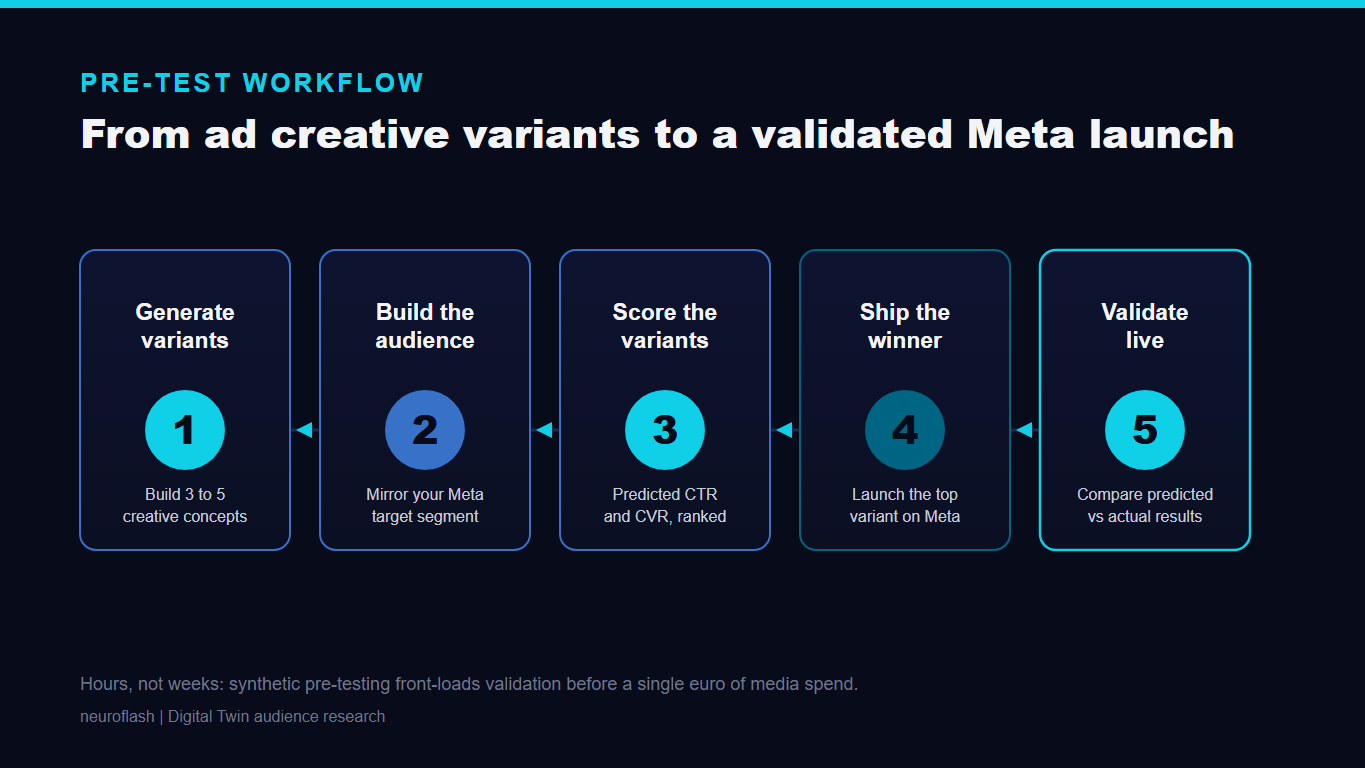
You pre-test ad creatives in five steps: generate the variants, build a synthetic audience that mirrors your Meta target, score every variant for predicted performance, ship the highest-ranked one, then validate the prediction against live results. The whole loop runs in hours, and only the winning concept ever reaches paid impressions, which is where the budget savings come from.
Step 1: Generate two to five creative variants
Start with a small, controlled set rather than a single hero creative. Three to five variants is the sweet spot: enough to cover meaningfully different angles (a benefit-led hook, a social-proof hook, a problem-agitation hook) without diluting the test. Change one variable at a time, the visual, the headline, or the offer framing, so the ranking is interpretable. Generative tools speed up production here, but production is not validation: a tool that makes ten variants still leaves you guessing which one to back.
Step 2: Build the synthetic audience to mirror your Meta segment
Define a panel profile that matches the segment you intend to target in Meta Ads Manager: age range, interests, income bracket, and the behavioral signals behind your lookalike seed. Precision here is what drives predictive validity, a panel calibrated to “urban parents, 30 to 45, premium-convenience buyers” will rank creatives very differently from a generic national sample. This is the same discipline as validating AI-generated audience segments before you trust them in a campaign.
Step 3: Score each variant for predicted CTR and conversion intent
Run every variant through the synthetic panel and collect a predicted performance score, typically engagement, click-through, and conversion intent, for each one. Dedicated creative-scoring tools such as AdCreative.ai and Madgicx assign these scores from large pools of historical ad data, with AdCreative.ai claiming over 90 percent accuracy on which ads perform better.[6][7] A synthetic-audience layer adds what those tools lack: a calibrated, segment-specific human signal rather than a pattern averaged across everyone else’s accounts. Standalone simulators such as SightsAI focus on the prediction itself; a Digital Twin research layer supplies the grounded audience data underneath it.
Step 4: Ship the winning variant to Meta
Enter Meta Ads Manager with a pre-validated pairing rather than an equal-split test. Launch the top-ranked variant as your primary creative, drop the concepts the panel scored weakest before they consume budget, and hold the runner-up in reserve for iteration once live data flows. Because the audience profile is already defined, the same pre-test tells you which sub-segment responded most strongly, sharpening your ad set structure on day one.
Step 5: Validate the prediction against live results
Pre-testing is a prediction, not a guarantee, so close the loop. Once the winning creative has run long enough to gather statistically meaningful data, compare actual CTR and conversion rate against the predicted ranking. Logging this prediction-versus-actual gap over several campaigns is how you build trust in the method and tune your audience profiles, and it is the practical side of benchmarking synthetic audience accuracy on your own creative.
How accurate is synthetic pre-testing for ad creatives?
Synthetic pre-testing reaches 85 to 95 percent aggregate parity with real human panels when the model is calibrated on real survey data, which is accurate enough to rank creative variants reliably before launch. In a double-blind test, EY found a 95 percent correlation between a thousand synthetic personas and its real survey results, produced in days for a fraction of the cost.[8] Generic LLM prompts, by contrast, land closer to 55 percent.
That gap is calibration data, not model size. A prompt to ChatGPT or Copilot returns a confident-sounding average; it has no grounding in how a specific segment actually responds. This is exactly where a Digital Twin research layer like neuroflash sits, feeding those same agents calibrated audience signals via API or MCP rather than competing with them. For the full picture on how to read parity figures and tool claims, see our work on the accuracy of AI pre-testing tools.
What does pre-testing cover beyond the creative itself?
Pre-testing covers the full pre-click experience, not just the ad image: the hook and headline, the message and CTA, and the landing page the click lands on. A creative that wins the auction but sends traffic to a mismatched page still wastes spend, so the strongest workflows pre-test each layer against the same audience profile for consistency.
In practice that means running headline and CTA variants through the panel the way you ran the visuals, the discipline covered in message testing on ad copy and CTAs, and checking that the destination page carries the same promise, the focus of landing page optimization with synthetic audiences. Documented case studies on synthetic audiences and ad performance show the compounding effect when creative, message, and landing page are pre-validated against the same segment rather than in isolation.
How neuroflash Digital Twins fit into your ad pre-testing workflow
neuroflash is not a chatbot or an LLM access tool. Your stack already has Copilot, Claude, Langdock, or ChatGPT for that. neuroflash is the Digital Twin audience research layer those agents call for calibrated, human-grounded signals, via API or MCP. It pre-tests ad creatives against calibrated synthetic audiences before launch, so the variant you scale is the one a real-grounded panel already favored.
- 1,000,000+ real consumer profiles as the calibration base, collected since 2017
- 85 to 95 percent predictive parity with real human survey panels (versus around 55 percent for generic LLM prompts)
- Results in minutes, not 4 to 8 weeks of traditional fieldwork
- API and MCP access, plug Digital Twins into ChatGPT, Claude, Copilot, Langdock, or any agent that speaks MCP
- Validated by 80+ academic studies, used by Fortune-500 brands for Decision Security
Score your creative variants against calibrated profiles in minutes, then enter Meta Ads Manager with a pre-validated winner instead of an equal-split guess. Start free.

FAQ
What does it mean to pre-test an ad creative?
Pre-testing an ad creative means evaluating it before launch to predict how it will perform, rather than launching it and reading performance from live campaign data. With AI synthetic audiences, you score two to five variants against a calibrated consumer panel that mirrors your target segment and receive a ranked prediction of engagement and conversion intent in minutes, so only the strongest concept reaches paid impressions.
How do I pre-test ad creatives for Meta Ads specifically?
Define a synthetic audience profile that matches your Meta target segment, including the demographics and behavioral signals behind your lookalike seed, then run your creative variants through it to get a predicted performance ranking. Take the top-ranked variant into Meta Ads Manager as your primary creative, hold the runner-up for iteration, and discard the concepts the panel scored weakest before they consume budget.
How many creative variants should I pre-test at once?
Two to five variants is the practical range. Fewer than two gives you nothing to compare; more than five dilutes the test and makes results harder to interpret. Keep the differences meaningful and controlled, change one variable at a time such as the visual, the headline, or the offer framing, so the ranking tells you why one variant won, not just that it did.
Is AI creative pre-testing accurate enough to trust before launch?
For ranking variants, yes. Well-calibrated synthetic panels grounded in real survey data show 85 to 95 percent aggregate parity with real human panels, and EY reported a 95 percent correlation in a double-blind test against its own survey.[8] That is accurate enough to reliably separate strong concepts from weak ones before spend, though you should still validate the prediction against live results over time.
Do I still need to A/B test if I pre-test creatives?
Pre-testing and live A/B testing are complementary, not mutually exclusive. Pre-testing front-loads the decision so you launch fewer, stronger variants and waste less budget discovering losers; live A/B testing then confirms the winner and fine-tunes it on real traffic. The combination launches a pre-validated shortlist instead of paying to test every concept from scratch.
My Take
As Advantage+ and Performance Max absorb more of the media-buying job, the creative is fast becoming the only lever performance marketers fully own, and it is also the one most teams still validate last, after the money is spent. Pre-testing reverses that. The teams that bake a synthetic pre-test into the campaign brief, the way they already bake in a budget and a target audience, will consistently launch stronger creative than teams that rely on live optimization to surface the answer. The tooling is no longer the bottleneck; the discipline of testing before spend is.
References
- AdSkate (2025): “Synthetic Audiences in Advertising Explained.” https://www.adskate.com/blogs/synthetic-audiences-advertising-explained
- ATTN Agency (2025): “AI-Powered Creative Testing: How to Find Winning Ads 3x Faster.” https://www.attnagency.com/blog/ai-creative-testing-paid-social
- Nielsen (2017): “When it Comes to Advertising Effectiveness, What is Key?” https://www.nielsen.com/insights/2017/when-it-comes-to-advertising-effectiveness-what-is-key/
- ATTN Agency (2025): “AI-Powered Creative Testing.” https://www.attnagency.com/blog/ai-creative-testing-paid-social
- AIM Multiple (2025): “Audience Simulation: Can LLMs Predict Human Behavior?” https://aimultiple.com/audience-simulation
- AdCreative.ai (2026): “Score and Improve Ad Creatives Before Spending with AI.” https://www.adcreative.ai/creative-scoring
- Madgicx (2026): “How to Predict Ad Performance Before You Spend.” https://madgicx.com/blog/predict-ad-performance
- Solomon Partners (2025): “Synthetic Data is Transforming Market Research” (EY 95 percent correlation study). https://solomonpartners.com/insights/reports/synthetic-data-is-transforming-market-research/
- Meta for Business (2017): “High-Quality Creative Increases Ad ROI.” https://www.facebook.com/business/news/insights/high-quality-creative-increases-ad-roi
- Marketing Charts (2017): “Creative Quality Has Biggest Impact on Ad Effectiveness.” https://www.marketingcharts.com/advertising-trends-80662
- Madgicx (2026): “How AI Creative Performance Prediction Achieves 90% Accuracy.” https://madgicx.com/blog/creative-performance-prediction
- Digiday (2024): “WTF are synthetic audiences?” https://digiday.com/media/wtf-are-synthetic-audiences/