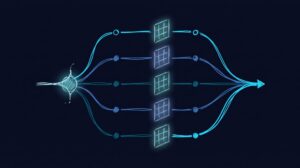
Every launch carries a question that keeps insight teams up at night: will this actually work with real people? The traditional answer has been to ship a version, split the audience, measure the difference, and wait. But waiting two to eight weeks for statistical significance, while burning ad budget on a concept that may already be broken, is an increasingly expensive bet. A faster path now exists. Synthetic audiences are AI-powered audience models built from millions of real consumer profiles, trained to respond to concepts, messages, and products the same way actual survey panels do, but in minutes rather than weeks. [1]
That shift matters. In 2025, one controlled experiment found AI digital twin panels matched real human survey results with 94% accuracy across concept-reaction questions. [2] That is not a replacement for live market feedback, but it is a pre-filter that changes when and how you use the expensive stuff. This article compares synthetic audiences vs A/B testing across accuracy, speed, cost, and use cases, and gives you a practical decision framework for choosing the right tool at the right stage.
TL;DR
- Synthetic audiences are AI audience models that simulate real consumer responses in minutes, before a single dollar of live traffic is spent.
- A/B testing is the gold standard for post-launch optimization, but requires thousands of visitors and two to eight weeks to reach significance.
- Calibrated digital twin panels reach 85 to 95 percent predictive parity with real human surveys; generic LLM prompts land around 55 percent.
- AI pre-testing is best for concept screening, headline testing, pricing sensitivity, and budget-constrained validation before launch.
- A/B testing is best for post-launch conversion optimization where live traffic already exists.
- The highest-return approach combines both: synthetic pre-testing to eliminate weak concepts early, live A/B testing to optimize survivors.
What are synthetic audiences in market research?
Synthetic audiences in market research are AI-generated panels of simulated consumers, each modeled on real demographic, psychographic, and behavioral data, that respond to research stimuli such as concepts, messages, and price points as a real survey panel would. Unlike purely statistical synthetic data, modern synthetic audiences are built by training large language models on millions of verified human survey responses, giving them calibrated response patterns rather than statistically plausible noise.
The distinction from generic AI chatbots is critical. Asking ChatGPT “how would a 35-year-old German mother react to this ad?” is not a synthetic audience. A synthetic audience is a structured, sampled panel of individually modeled personas, each with consistent attribute sets, drawn from a validated population-representative pool. The output is not one opinion. It is a distribution of responses across hundreds or thousands of simulated individuals, with the same margin-of-error math that applies to real panels.
The concept has clear roots in academic work on “digital twins” of human decision-making. A 2025 Stanford and DeepMind joint study found that large language models, when given sufficient context about individuals, could predict real human behavior with approximately 85 percent accuracy in controlled experiments. In market research terms, the state of the art for purpose-built, calibrated synthetic panels runs between 85 and 95 percent predictive parity with matched human survey panels, according to multiple independent validation studies. [3]
One important clarification on terminology: synthetic audiences, synthetic respondents, digital twin panels, and AI consumer panels all describe variations of the same category. The quality differences between them are large and depend almost entirely on the depth of the underlying training data and the calibration methodology used.
What are the core limitations of traditional A/B testing?
Traditional A/B testing has five structural constraints that determine when it is the right tool and when it becomes an expensive bottleneck: traffic volume, time to significance, platform dependency, the pre-launch gap, and iteration cost per variant. Understanding each constraint is essential before choosing between synthetic pre-testing and live experimentation.
Traffic requirements. A page converting at 2 to 5 percent typically needs at least 1,000 to 2,000 conversions per variant to detect a 10 to 20 percent relative lift at 95 percent confidence. [4] For sites with fewer than 10,000 monthly visitors, A/B testing is structurally unreliable for most hypotheses, and the only way to accelerate results is to widen the minimum detectable effect to the point where only very large changes register.
Time to statistical significance. The industry consensus is that a well-run A/B test should run for a minimum of two full business cycles, usually two weeks, regardless of when the significance threshold is crossed. [5] Running tests to early significance is one of the most common sources of false positives in conversion optimization. In practice, most A/B testing programs see tests run two to eight weeks before a confident read is available.
Platform dependency. A/B tests measure what users do on a specific surface at a specific moment. A test run on a landing page tells you which version converts better for the traffic that the page is currently receiving. It cannot tell you whether a different audience would respond differently, and it cannot be run before that surface exists.
No pre-launch testing. This is the most expensive limitation. A product name, a pricing tier, a campaign concept, an ad headline: none of these can be A/B tested until they have been built, deployed, and served to real users. The failure mode is finishing a production build and discovering a structural audience issue that could have been caught in a 20-minute synthetic pre-test.
Cost per variant. Traditional A/B testing at scale is not free. Platform costs aside, each additional variant requires proportionally more traffic and more time to significance. A five-variant test against a 2 percent baseline conversion rate on a low-traffic site may require months to reach a reliable read. Development time to instrument and QA each variant adds further cost that accumulates quickly across a testing roadmap.
How do synthetic audiences compare to A/B testing on accuracy, speed, and cost?
Synthetic pre-testing and A/B testing are not competing tools for the same job: they answer different questions at different stages of the campaign or product lifecycle. Synthetic audiences answer “which concept has the highest probability of working with this audience?” before anything is built. A/B testing answers “which live version converts better?” after deployment. The accuracy comparison depends on what you are measuring and when.
For pre-launch concept validation, calibrated synthetic panels are the only option that exists. A/B testing cannot run. For post-launch conversion optimization on high-traffic surfaces, live A/B testing produces the ground truth. The question is: how much accuracy do you lose by using a synthetic pre-test instead of waiting for live data? The evidence suggests the loss is smaller than most teams assume.
Independent studies using fine-tuned synthetic models show they deviate from matched human panels by an average of 0.07 standard deviations (Cohen’s D), compared to 0.87 for general-purpose LLMs like GPT-4 used without calibration. [6] That is roughly a 12x accuracy advantage for purpose-built synthetic panels over off-the-shelf AI, and the gap between calibrated synthetic panels and real human surveys is within the margin of error of most concept screening studies.
For a direct comparison, see how synthetic audience accuracy benchmarks against traditional human panels across different research contexts.
| Factor | Synthetic Pre-Testing | A/B Testing |
|---|---|---|
| Time to insight | Minutes | 2-8 weeks |
| Cost | Low (API calls) | High (traffic + dev time) |
| Pre-launch capable | Yes | No |
| Traffic required | None | Thousands of visitors |
| Iteration speed | Hours | Weeks |
| Sample size | Configurable (100-10,000+) | Determined by available traffic |
| Statistical basis | Calibrated simulation | Observed behavior |
| Best for | Concept validation | Post-launch optimization |
| Accuracy ceiling | 85-95% panel parity | Ground truth (100%) |
The practical implication: a team testing five headline variants and three pricing tiers before launch can run all 15 combinations through a synthetic panel in an afternoon and arrive at a final two or three combinations worth deploying. Those survivors are then A/B tested live with a dramatically smaller variant set and faster time to significance.

5 use cases where AI pre-testing outperforms live A/B experiments
There are specific scenarios where synthetic pre-testing consistently delivers a better return than routing the same question through a live A/B test. These five use cases represent the clearest wins for AI audience research, and each one maps to a structural limitation of live experimentation.
1. Pre-launch concept validation
A/B testing cannot reach pre-launch, by definition. Before a product, campaign, or creative asset exists in a deployable form, the only structured way to get audience-representative feedback on multiple variants is through research. Traditional concept testing with human panels takes two to six weeks and costs $15,000 to $75,000 per study. [7] Synthetic concept testing on calibrated panels runs in hours at a fraction of that cost, with accuracy validated at 80 to 90 percent question-level agreement with matched human panels.
For teams launching new products, entering new markets, or testing brand positioning, this is not a marginal improvement. It is structural: synthetic pre-testing makes a class of questions answerable that were previously skipped due to budget or time.
2. Message and headline testing
Ad headline testing is one of the clearest wins for synthetic pre-testing. Writing 20 headline variants and finding which three perform best would require months of A/B testing on a live ad account, with meaningful spend behind each variant. The same task on a synthetic audience panel takes hours and costs a fraction. The output is a prioritized shortlist, not a final answer, but the prioritization alone saves weeks of wasted spend on underperforming variants.
Published research on AI-powered concept testing shows 80 to 95 percent agreement with human benchmarks on stated-preference and concept-reaction questions. [8] For headline and message testing, where the key metric is directional preference rather than conversion rate, this accuracy is sufficient to make confident cuts before any live spend is committed.
3. Pricing sensitivity research
Pricing research is structurally difficult to A/B test on most live surfaces. The traffic volume required to detect a 10 percent pricing lift at statistical significance is substantial, and the ethical and commercial complexity of showing different prices to different users at scale is a constraint many teams are not willing to manage. Synthetic panels trained on consumer price sensitivity data can model van Westendorp, Gabor-Granger, and conjoint price elasticity curves in hours. One validation study found a synthetic pricing model produced a price elasticity curve closely matching real-world consumer data for the same product category. [9]
4. Audience segmentation testing
A/B testing on a live site or ad platform tests a concept against whatever audience happens to be visiting. It cannot easily tell you whether the concept performs differently across segments, without running a much more complex factorial design. Synthetic panels are configurable: you can run the same creative against a simulated sample of 500 millennial women, then a sample of 500 Gen X men, and compare the response distributions in the same session. That level of segmentation flexibility is not available in live A/B testing without a substantial traffic and time investment.
5. Budget-constrained scenarios
Many of the most important creative, positioning, and product decisions happen in organizations that do not have the traffic to run A/B tests or the budget to run traditional market research. Early-stage startups, regional campaign teams, and teams launching into new markets all face this constraint. For them, the choice is not “synthetic audiences vs A/B testing.” The choice is “synthetic audiences vs no testing at all.” In that framing, 85 to 95 percent panel parity is an enormous improvement over a gut-call.
For a detailed comparison of AI pre-testing platforms and their accuracy benchmarks, see AI pre-testing tools: accuracy and comparison.

How do AI pre-testing workflows integrate into modern marketing stacks?
AI pre-testing integrates into modern marketing stacks via API and MCP (Model Context Protocol) interfaces that allow any AI workflow, agent, or orchestration layer to call a synthetic audience panel as a structured data source, receiving response distributions rather than single answers. The integration does not require replacing existing tools: it adds a research layer that existing AI agents, CRM platforms, and content workflows can query on demand.
The key architectural point is that synthetic audience research is a service, not a standalone application. A marketing team running campaigns through Langdock, Claude, Copilot, or a custom agentic pipeline can add a digital twin research call to the same workflow, querying a calibrated panel at the point where a human researcher would previously have drafted a survey brief and waited three weeks for results.
This is where the accuracy gap between generic AI and calibrated panels becomes decisive. Generic LLM prompts on ChatGPT or Copilot reach around 55 percent panel parity. The gap is calibration data, not model size, and it is exactly where a Digital Twin research layer like neuroflash sits, feeding those agents calibrated audience signals via API or MCP.
In practice, the integration pattern looks like this: a creative team working in their preferred AI workflow asks the research API “how would 35-to-45-year-old German parents respond to this campaign concept?” The digital twin layer queries a calibrated synthetic panel of that demographic, returns a structured response distribution with sentiment breakdowns, attribute ratings, and open-text summaries, and that data flows into the same workflow the team was already using. No separate research project. No three-week fieldwork cycle.
The MCP integration model is particularly significant for agentic AI workflows, where agents need to make audience-grounded decisions at planning time, not at reporting time. An agent building a media plan or writing campaign copy can query the digital twin API mid-task and adjust its output based on calibrated audience signals, rather than relying on the agent’s training data for consumer behavior assumptions.
When to use synthetic audiences vs A/B testing: a decision framework
The choice between synthetic pre-testing and live A/B testing follows a decision tree driven by four factors: launch stage, traffic availability, budget, and speed requirements. Applying this framework before committing to either approach prevents the most common mistake, which is using A/B testing to answer questions that cannot be answered yet and using synthetic research to validate questions that require live behavioral data.
Decision point 1: Is the question pre-launch or post-launch? If the asset, concept, or variant does not yet exist in deployable form, synthetic pre-testing is the only structured option. A/B testing is not available pre-launch. This alone eliminates the debate for a large class of research questions.
Decision point 2: Do you have sufficient live traffic? If a page or surface receives fewer than 10,000 monthly visitors, A/B testing at conventional confidence levels requires months per test, making it impractical for most iteration cycles. Synthetic pre-testing has no traffic dependency.
Decision point 3: How many variants need to be evaluated? If the question involves more than two or three variants, A/B testing at scale requires exponentially more traffic and time. Synthetic panels can evaluate 10 to 100 variants in the same time as a two-variant A/B test, making them better suited for early-stage screening.
Decision point 4: Is the goal directional screening or ground-truth conversion measurement? If the goal is to identify which two or three concepts from a set of ten deserve investment, synthetic pre-testing is accurate enough and far faster. If the goal is to measure the exact conversion lift of a specific live variant, A/B testing provides the only statistically valid answer.
The recommended default: use synthetic pre-testing to screen, select, and iterate on concepts before launch. Then deploy two or three survivors into a focused live A/B test with a clear conversion metric. This sequence reduces test duration, eliminates weak variants before spend, and produces a cleaner signal from the A/B test because the variants in the live test are already pre-qualified.
Run your first AI pre-test with neuroflash — before a single real respondent sees it
neuroflash plugs Digital Twin audience research into your existing AI stack — Copilot, Claude, Langdock, ChatGPT, or your own agentic setup — via API or MCP. Run concept tests, ad pre-tests, and messaging validation against calibrated consumer profiles in minutes. 85 to 95 percent panel parity, 1M+ real profiles, validated by 80+ academic studies. Start free.

FAQ
What is the difference between synthetic audiences and A/B testing?
Synthetic audiences are AI-simulated consumer panels that respond to concepts, messages, and products before anything is built or deployed. A/B testing is a live experiment that shows two or more real variants to real users and measures which version converts better. Synthetic audiences answer pre-launch questions; A/B testing answers post-launch optimization questions. They operate at different stages and are best used in sequence rather than competition.
How accurate are AI synthetic audiences compared to real human surveys?
Calibrated, purpose-built synthetic panels reach 85 to 95 percent predictive parity with matched human survey panels on stated-preference and concept-reaction questions. Generic LLM prompts without calibration data score around 55 percent. The gap is determined by the quality and depth of the underlying training data, not model size. An independent Qualtrics validation study found their fine-tuned synthetic model deviated from human panel responses by an average of 0.07 standard deviations, compared to 0.87 for GPT-4 used without calibration.
Can synthetic audiences replace A/B testing entirely?
No. Synthetic audiences cannot measure live conversion behavior on a real surface. A/B testing measures what users actually do; synthetic pre-testing predicts what a panel of simulated consumers says it would prefer. For post-launch optimization, where the goal is measuring real conversion lift on a live deployment, A/B testing remains the ground truth. Synthetic audiences work best as a pre-filter that eliminates weak concepts before live testing, making A/B tests shorter, cheaper, and more likely to surface a real winner.
How long does AI pre-testing take compared to live experiments?
A synthetic pre-test on a calibrated panel typically returns results in minutes to a few hours. A traditional A/B test requires two to eight weeks at minimum, including instrument setup, traffic accumulation, and the minimum business cycle coverage needed to avoid false positives from weekday or seasonal variation. For teams running multiple concept variants simultaneously, synthetic pre-testing can evaluate all variants in a single session versus months of sequential live testing.
How do I integrate synthetic audience research into my AI marketing stack?
Modern Digital Twin research platforms expose their panels via API and MCP (Model Context Protocol) interfaces. This means any AI workflow, agent, or orchestration tool that can make an API call can query a synthetic audience panel. A team using Copilot, Claude, Langdock, or a custom agentic pipeline can add a digital twin research call to their existing workflow without replacing any tools. The research result, a structured response distribution from a calibrated consumer panel, returns to whatever AI environment called it.
What types of questions are synthetic audiences best at answering?
Synthetic audiences perform best on stated-preference questions: which concept is more appealing, which headline is more relevant, which price feels fair, which message resonates with which segment. They are less reliable for predicting novel behavioral responses, long-horizon purchase decisions, and highly context-dependent in-store or situational behaviors. The practical rule: if it is a question you could answer with a well-designed survey, a calibrated synthetic panel can usually answer it faster and cheaper.
What is the main risk of using synthetic audiences without validation?
The main risk is over-relying on uncalibrated AI outputs. Using a generic LLM as a stand-in for market research, without a purpose-built calibration layer on real consumer data, produces outputs that sound confident but correlate poorly with actual human responses. This “hyper-accuracy” failure mode, where AI gives suspiciously clean answers unlike real human variability, is well-documented in academic literature. The mitigation is using panels with published validation studies and checking that the synthetic panel replicates known benchmark results before using it for novel research.
My Take
The synthetic audiences vs A/B testing debate mostly disappears once you place each tool at the right stage of the decision lifecycle. A/B testing is not better than synthetic pre-testing; it is later. And later is not always affordable.
The real shift happening in 2025 and 2026 is not that synthetic audiences are replacing anything. It is that the cost of asking “will this work?” has collapsed to the point where teams can ask the question at every stage, not just the final one. A brand that used to run one A/B test per month because setup and traffic costs limited their cadence can now run ten synthetic concept tests per week and bring only the strongest ideas to live testing.
That compression matters most for teams that were previously forced to make gut-call decisions at the concept stage, not because they preferred it, but because the research budget and timeline made structured validation impractical. For those teams, calibrated Digital Twin platforms like neuroflash are not a marginal efficiency gain. They are a structural shift in which decisions get evidence behind them.
The accuracy caveat is real: 85 to 95 percent panel parity is not 100 percent. For decisions with very high stakes and available traffic, live A/B testing remains the more defensible choice. But for the large majority of campaign and product decisions made before launch, with tight timelines and constrained budgets, synthetic pre-testing at 85 to 95 percent accuracy is orders of magnitude better than the alternative, which is not testing at all.
References
[1] Altair Media (2026): “Synthetic Audiences in Market Research: Hype, Reality and Outlook for 2026.” https://altair-media.com/posts/synthetic-audiences-in-market-research-hype-reality-and-outlook-for-2026
[2] Altair Media (2026): “Synthetic Audiences in Market Research.” https://altair-media.com/posts/synthetic-audiences-in-market-research-hype-reality-and-outlook-for-2026
[3] Fish.dog (2026): “AI Consumer Panels: The 2026 Buyer’s Guide.” https://fish.dog/news/ai-consumer-panels-the-2026-buyers-guide
[4] Convert.com (2024): “A/B Testing Stats Every Optimizer Should Know.” https://www.convert.com/blog/a-b-testing/ab-testing-stats/
[5] AB Tasty (2024): “How Long Should You Run an A/B Test?” https://www.abtasty.com/blog/how-long-run-ab-test/
[6] GreenBook (2025): “Testing Synthetic Data Against Academic Benchmarks: A Replication Study.” https://www.greenbook.org/insights/data-science/testing-synthetic-data-against-academic-benchmarks-a-replication-study
[7] GetMinds.ai (2026): “AI Concept Testing Platforms 2026: The Comparison Guide.” https://getminds.ai/blog/ai-concept-testing-platforms-2026
[8] Listen Labs (2025): “Concept Testing Market Research: AI-Powered Validation.” https://listenlabs.ai/articles/concept-testing-market-research-guide/
[9] PyMC Labs (2024): “Synthetic Consumers: A Practical Guide.” https://www.pymc-labs.com/blog-posts/synthetic-consumers-a-practical-guide
[10] ESOMAR (2025): “Synthetic Respondents Enables Businesses to Make Decisions 95% Faster.” https://esomar.org/newsroom/synthetic-respondents-enables-businesses-to-make-decisions-95-faster
[11] MarTech (2024): “Are Synthetic Audiences the Future of Marketing Testing?” https://martech.org/are-synthetic-audiences-the-future-of-marketing-testing/
[12] GreenBook (2025): “The Death of the Survey? The Future of Surveys in a World of Synthetic Data.” https://www.greenbook.org/insights/data-science/the-death-of-the-survey-the-future-of-surveys-in-a-world-of-synthetic-data
[13] HubSpot (2024): “How to Determine Your A/B Testing Sample Size and Time Frame.” https://blog.hubspot.com/marketing/email-a-b-test-sample-size-testing-time
[14] NIM (2025): “Leaving Insight to Digital Twins? Promise, Progress and Limits of Synthetic Respondents.” https://www.nim.org/en/publications/detail/leaving-insight-to-digital-twins
[15] Influencers Time (2025): “AI-Driven Synthetic Audiences for Pre-Campaign Testing 2025.” https://www.influencers-time.com/ai-driven-synthetic-audiences-revolutionizing-marketing-2025/