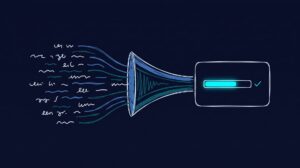
Market research is shifting to MCP, short for Model Context Protocol, because AI agents without a reliable connection to real data simply guess, and guessing is no foundation for business decisions. Gartner expects 40% of enterprise apps to carry task-specific AI agents by the end of 2026, up from under 5% in 2025[3]. Without real context, those agents fill gaps with plausible-sounding fiction. For research, that is forcing a shift away from two older approaches at once, slow static panels and fast but ungrounded generic AI, toward agents and synthetic audiences connected via MCP to real, verifiable data.
The Grounding Gap: Why So Many AI Agents Are Failing
Grounding means anchoring an AI model’s answers in verifiable data rather than patterns memorized during training. Without it, a model does not know that it does not know something, and answers anyway.
That is not a minor detail. Gartner predicts more than 40% of agentic AI projects will be canceled by the end of 2027, citing escalating costs, unclear business value, and inadequate risk controls[1], much of it tracing back to one root cause: agents deployed without a solid connection to trustworthy data.
OpenAI’s own 2025 research makes the mechanism explicit. Hallucinations are not a mysterious bug, the paper argues, but a predictable statistical outcome of how models are trained and scored, which reward a confident guess over an honest “I don’t know”[2]. Put an agent like that in front of a business question with no real data behind it, and it will answer anyway. It will just be wrong.
What this means for your team: the agent itself is rarely the problem. The missing, dependable link to trustworthy data is.
MCP: The Connective Layer Agents Were Missing
Model Context Protocol, or MCP, is an open standard Anthropic introduced in November 2024 to let AI assistants connect directly to external data sources[4]. Instead of relying purely on training data, MCP gives a model a live channel to ask a real system for real information and get a real answer back.
Adoption has been unusually fast. Within about a year, MCP reached over 97 million monthly SDK downloads and roughly 10,000 active servers, with first-party support from Anthropic, OpenAI, Google, and Microsoft[7]. In December 2025, Anthropic donated MCP to the newly formed Agentic AI Foundation under the Linux Foundation, alongside OpenAI and Block, making it a vendor-neutral, community-governed standard[5] backed by AWS, Cloudflare, GitHub, and Bloomberg[6], a move TechCrunch framed as an industry-wide bet on a shared connective layer for agents[11].
That connective layer is what closes the grounding gap. Our pillar guide to Digital Twins and MCP goes deeper into how it works. In short: MCP is the plumbing, and what you connect to it determines whether an agent is grounded or guessing.

From Panels to Prompts, and Now to Grounded Agents
Market research has made this journey twice already, and both older stops have real limits.
Traditional panels are dependable but slow, often four to eight weeks from fielding to readout, by which point the market question has moved on. Generic AI solved the speed problem but introduced a trust problem. A 2025 Qualtrics study found that 62% of market researchers had already used synthetic data in the past six months[8]. Yet a 2026 State of Synthetic Users report found a striking gap: 97% of research professionals use AI somewhere in their workflow, but only 8% use synthetic-participant tools regularly for decision-critical work, citing exactly the grounding concern above[9].
That gap between AI usage and AI trust is the grounding gap in miniature. Researchers are not rejecting AI, they are rejecting AI that cannot show its work. Our breakdown of the best MCP servers for marketing and market research covers which connected sources hold up under scrutiny.
What this means for your team: the fastest tool is not automatically the most useful one. The one that earns a seat in decision-making is traceable back to a real, checkable source.

What This Means for Research Teams
This trend has three concrete implications for research teams today.
First, expect AI agents to become a standard part of the research stack, not a novelty on top of it. With 40% of enterprise apps expected to carry task-specific agents by 2026[3], insights tools without an agent-facing interface will look dated fast.
Second, evaluate any AI research tool by one question: what is it grounded in? A model with no connected data source is a guessing engine with good manners; one connected via MCP to real survey profiles is a different category of tool.
Third, connection matters more than the interface. Our piece on Context-as-a-Service via n8n, Zapier, and Make covers how MCP lets research data flow into the automation tools teams already use, wired into the workflow instead of a chat window.
Where the Market Is Headed
The direction is visible from more than one angle. GWI, whose data comes from close to 1 million real internet users surveyed yearly across 50+ markets, launched its own MCP integration with Claude in late 2025 to give AI assistants grounded audience data instead of scraped or outdated information[10]. A real panel provider making the same bet: connect through MCP, or watch agents make things up in your category.
This is a market-wide correction, not a single-vendor story. The generic-AI phase showed what was possible; the MCP phase makes it dependable enough to act on. A related shift: as agents and answer engines research brands directly, that same grounded data becomes a query engine for visibility, covered in Digital Twins as a query engine for GEO.
How neuroflash Digital Twins Close the Grounding Gap
neuroflash built Digital Twins around exactly this principle: synthetic audiences are only as useful as the real data grounding them.
Every Digital Twin is calibrated against neuroflash’s base of over 1,000,000 real human survey profiles, not scraped internet text. That grounding shows up as measurable accuracy: 80-90% alignment with real-world outcomes, compared to roughly 55% for generic AI tools answering the same questions. Because the twins are pre-calibrated rather than freshly hallucinated per prompt, teams get answers in minutes instead of the four-to-eight weeks a traditional panel study takes.
The internal mantra: we predict, we don’t guess. That is what neuroflash calls Decision Security, the confidence of knowing an answer is grounded before a campaign, product, or message goes live, not after. The platform is made in Germany, built to GDPR standards, hosted in the EU, and available both in-app and via API and MCP for teams that want grounded audience data flowing directly into their own agents and workflows.
Talk to Grounded Audiences on Your Terms
neuroflash connects your AI agents and workflows to synthetic audiences grounded in real survey data via API and MCP, so research answers hold up instead of hallucinating under pressure. See it running against your own questions.

FAQ
What does MCP mean for market research?
MCP lets AI agents pull live data from a real source, such as a survey panel or synthetic audience platform, instead of relying only on training data. The agent answers grounded in verifiable data rather than guessing.
Why are so many AI agent projects being canceled?
Gartner points to unclear business value, rising costs, and weak risk controls, much of it tracing back to agents never properly connected to trustworthy data[1]. An ungrounded agent can look impressive in a demo and still fail in production.
Is synthetic research replacing traditional panels entirely?
Not entirely, and not yet. Real panel data still has a clear role, which is why providers like GWI are connecting their panels to AI agents via MCP rather than stepping aside[10]. The shift combines real data with faster, grounded synthetic methods.
How is a grounded synthetic audience different from a generic AI chatbot’s guess?
A generic chatbot draws on training data and produces a plausible response with no way to verify it. A grounded synthetic audience, like neuroflash Digital Twins, is calibrated against real human survey profiles, checked against actual behavior instead of invented on the spot.
What should a team look for in an AI research tool in 2026?
Ask what the tool is grounded in, whether it connects via MCP to real, checkable data, and whether it discloses accuracy against real-world outcomes. Vague answers on any of these usually mean the tool is guessing.
Bottom Line
The grounding gap is the real story behind every headline about agentic AI hitting the mainstream in 2026. Agents are everywhere now, but one with no reliable connection to real data is just fast and wrong with confidence. MCP fixes that connection problem, and research shows it clearly: panels were dependable but slow, early generic AI was fast but ungrounded, and what is winning now is the combination of both. Teams that pick tools based on what they are grounded in, not just how quickly they respond, will be the ones making decisions they can stand behind next year.
Sources
[1] Gartner (2025): “Gartner Predicts Over 40% of Agentic AI Projects Will Be Canceled by End of 2027.” https://www.gartner.com/en/newsroom/press-releases/2025-06-25-gartner-predicts-over-40-percent-of-agentic-ai-projects-will-be-canceled-by-end-of-2027
[2] OpenAI (2025): “Why Language Models Hallucinate.” https://openai.com/index/why-language-models-hallucinate/
[3] Gartner (2025): “Gartner Predicts 40% of Enterprise Apps Will Feature Task-Specific AI Agents by 2026, Up from Less Than 5% in 2025.” https://www.gartner.com/en/newsroom/press-releases/2025-08-26-gartner-predicts-40-percent-of-enterprise-apps-will-feature-task-specific-ai-agents-by-2026-up-from-less-than-5-percent-in-2025
[4] Anthropic (2024): “Introducing the Model Context Protocol.” https://www.anthropic.com/news/model-context-protocol
[5] Linux Foundation (2025): “Linux Foundation Announces the Formation of the Agentic AI Foundation (AAIF), Anchored by New Project Contributions Including Model Context Protocol (MCP), goose and AGENTS.md.” https://www.linuxfoundation.org/press/linux-foundation-announces-the-formation-of-the-agentic-ai-foundation
[6] Anthropic (2025): “Donating the Model Context Protocol and Establishing the Agentic AI Foundation.” https://www.anthropic.com/news/donating-the-model-context-protocol-and-establishing-of-the-agentic-ai-foundation
[7] Model Context Protocol Blog (2025): “MCP Joins the Agentic AI Foundation.” https://blog.modelcontextprotocol.io/posts/2025-12-09-mcp-joins-agentic-ai-foundation/
[8] Greenbook (2025): “Smarter Insights, Faster Pace: AI’s Breakthrough in Market Research.” https://www.greenbook.org/insights/grit/smarter-insights-faster-pace-ais-breakthrough-in-market-research
[9] User Interviews (2026): “State of Synthetic Users Report.” https://www.userinterviews.com/state-of-synthetic-users-report
[10] GWI (2025): “GWI MCP Claude Integration.” https://www.gwi.com/gwi-mcp-claude-integration
[11] TechCrunch (2025): “OpenAI, Anthropic, and Block Join New Linux Foundation Effort to Standardize the AI Agent Era.” https://techcrunch.com/2025/12/09/openai-anthropic-and-block-join-new-linux-foundation-effort-to-standardize-the-ai-agent-era/