
The AI-powered market research digital twins vs traditional surveys accuracy comparison is the question every CMO, head of insights and procurement lead is now asking before signing the next contract[1]. The headline number is impressive: calibrated synthetic respondents matching real human panels at 85 to 95 percent parity on quantitative concept and pricing tests[2]. The other side of the same coin is that the same models can drop to 37 to 60 percent replication on complex studies and produce flat, sycophantic answers on qualitative depth if they are not built and validated with care[3]. This pillar guide unpacks what those numbers mean, how they were measured, where AI digital twins beat the old methods, where seasoned researchers are still right to demand a real human in the room, and how to evaluate any vendor claim with rigour rather than vibes.
TL;DR / Key Takeaways
- A Stanford and Google DeepMind study with 1,052 participants showed AI digital twins replicating individual survey answers at 85 percent accuracy, matching the test-retest reliability of the humans themselves two weeks later[4].
- Across calibrated commercial platforms, synthetic respondents hit 85 to 95 percent parity with real panels on concept and pricing tests, while generic ChatGPT-style prompts sit closer to 55 percent and can crash to 37 to 60 percent on complex studies[3][5].
- Traditional online panels measured against ARF probability benchmarks show 5 to 12 percent average absolute error on key questions, which is the real ground truth synthetic platforms now need to beat[6].
- Email survey response rates have collapsed from 20 to 25 percent in 2019 to 10 to 15 percent in 2025, so the legacy method is not the unchanging gold standard the industry pretends it is[7].
- AI digital twins win on speed, scale, longitudinal consistency and hard-to-reach segments. Traditional methods still win on deep emotion, ground-truth calibration, regulatory contexts and tail-end populations[8].
- The only honest accuracy claim is one with a published validation methodology, a confidence interval and an anchor on at least one real human data point[9].
The accuracy question, framed honestly
When an accuracy number reaches the C-suite, it usually arrives shorn of context. “Ninety percent accurate” sounds final. Any accuracy figure depends on four things the boardroom rarely asks about: which population was simulated, which question types were tested, which ground truth was used, and how the model was calibrated[2]. Move any of those four and the number moves with them.
The honest version of the question is therefore not “are AI digital twins as accurate as traditional surveys?” but “for which decision, under which calibration, and against which benchmark?” The field has matured enough to answer that more precise version with numbers, not opinions. Researchers who have been through enough vendor pitches will recognise the pattern from the panel-quality debates of the 2010s, when the Advertising Research Foundation’s Foundations of Quality 2 initiative had to map 51 non-probability panels against probability benchmarks to separate the claims from the data[6].
How traditional surveys earned their accuracy reputation
Traditional survey research did not become the default for four decades by accident. The infrastructure is impressive: probability and quota panels of millions of pre-screened respondents, decades of normative data, mature weighting models that adjust for non-response, and standardised methodologies enforced by ESOMAR and the Insights Association[10]. The BASES concept-testing system, built up over thirty years at Nielsen, codifies ranges of ten to fifteen percent absolute deviation between in-market performance and pre-launch forecasts[6]. ARF’s Foundations of Quality 2 study quantified the accuracy of fifty-one online panels and river samples against probability benchmarks and still anchors the industry’s understanding of error[6].
That reputation is real. It is also under quiet but serious pressure. Email survey response rates have fallen from 20 to 25 percent in 2019 to 10 to 15 percent in 2025, with telecom and financial services panels that once hit 30 percent now struggling to reach 12[7]. Panel fatigue is no longer a fringe concern: the average consumer is sent three to five feedback requests a week and has developed an automatic dismissal reflex[7]. GRIT data shows data-quality concerns up 40 percent year on year, driven by both Gen Z fatigue and worries about respondent integrity[5]. The ground truth that synthetic platforms must beat is not the ideal of a 1995 probability sample. It is a 2026 online panel with a 15 percent response rate and a growing tail of bots and inattentive respondents.
How AI Digital Twins reach accuracy: the calibration chain
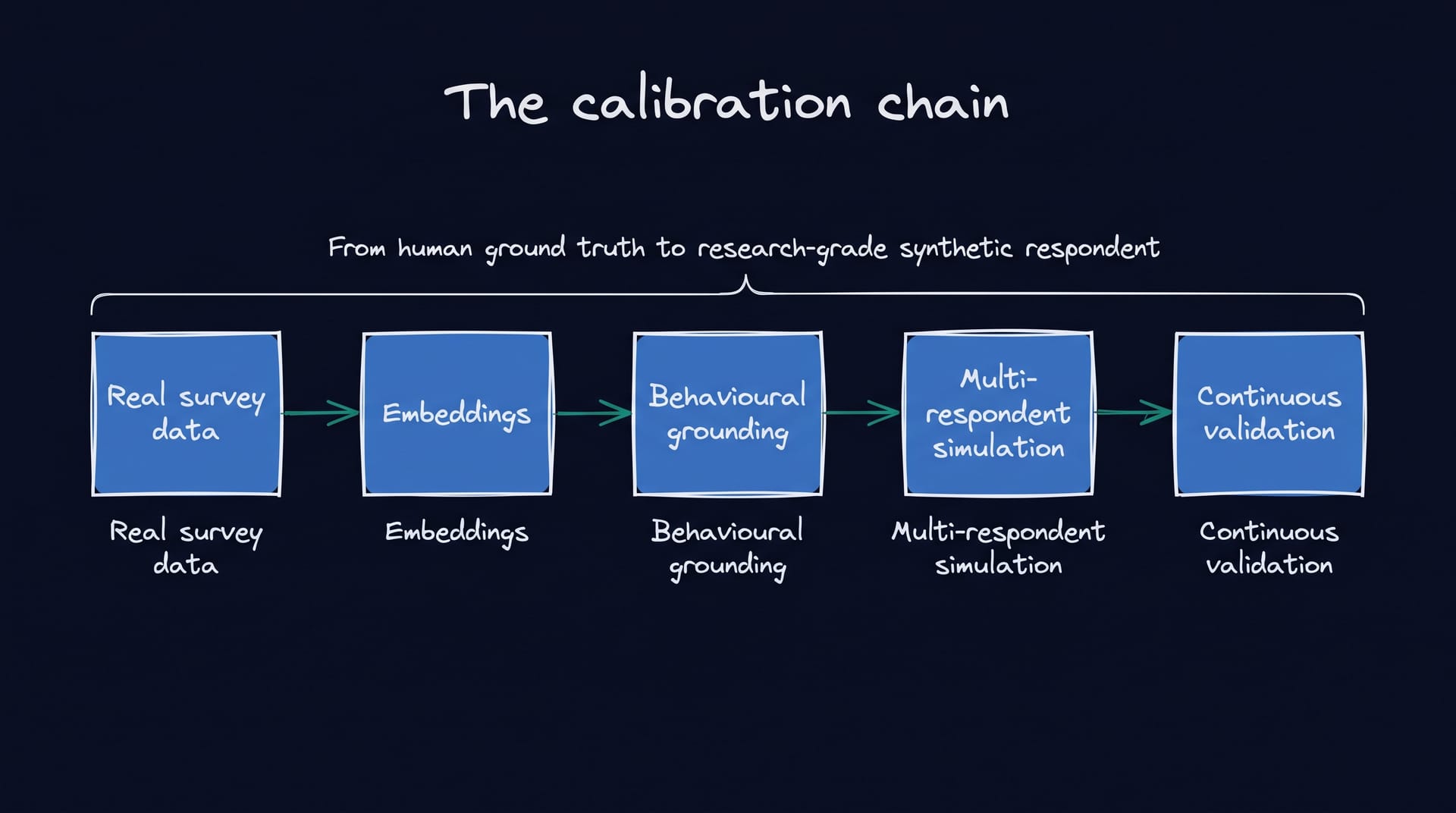
The platforms hitting 85 to 95 percent parity with human panels are not just very large language models with persona prompts. The accuracy comes from a chain of design choices, each of which has measurable impact[11]. The deeper mechanics are unpacked in our dedicated guide to the methodology of AI consumer panels, but the overview matters here because no accuracy claim is interpretable without knowing which links in the chain are present.
The first link is the training corpus: real survey responses, behavioural data, and interview transcripts at scale, ideally first-party and millions of records[8]. The second is embedding alignment, where each respondent’s lived data is encoded so the model interpolates plausibly across attributes rather than sampling stereotypes. The third is behavioural grounding, where the model is conditioned on observed actions rather than self-reports, which is precisely what the Stanford and Google DeepMind team showed produced an 85 percent match to the General Social Survey[4]. The fourth is multi-respondent simulation, where the platform produces a distribution rather than a point estimate so variance is preserved and modal answers do not flatten the tails. The fifth and most often skipped link is continuous validation against fresh human data, the only safeguard against the silent drift the Quirk’s analysis labelled “the shelf life of a synthetic panel”[12].
The Stanford architecture combined LLM reasoning with in-depth qualitative interviews of each of the 1,052 real participants and demonstrated that interview-grounded agents reduced political-ideology and racial bias compared to demographic-only agents[4]. Bain’s analyses converge on the same conclusion: synthetic customers built on top of real customer research, not in place of it, deliver comparable insights in half the time and at one third the cost[13].
The numbers: where synthetic hits parity and where it does not
This is where the accuracy debate either falls apart or finally pays off, depending on whether you are reading the headlines or the underlying studies.
The strongest evidence sits on quantitative, closed-ended work. The Stanford and Google DeepMind benchmark recorded 85 percent normalised accuracy on the General Social Survey, 80 percent agreement on the Big Five personality inventory, and 60 percent prediction accuracy on five separate behavioural economics games[4]. Simsurveys’ validation work across nine studies shows 80 to 90 percent question-level accuracy against live panel benchmarks[5]. A recent global candy company case study using Panoplai’s synthetic respondents matched human data at over ninety percent[5]. Ipsos’s own product-testing trials with synthetic data report comparable directional accuracy at meaningfully reduced questionnaire length[14].
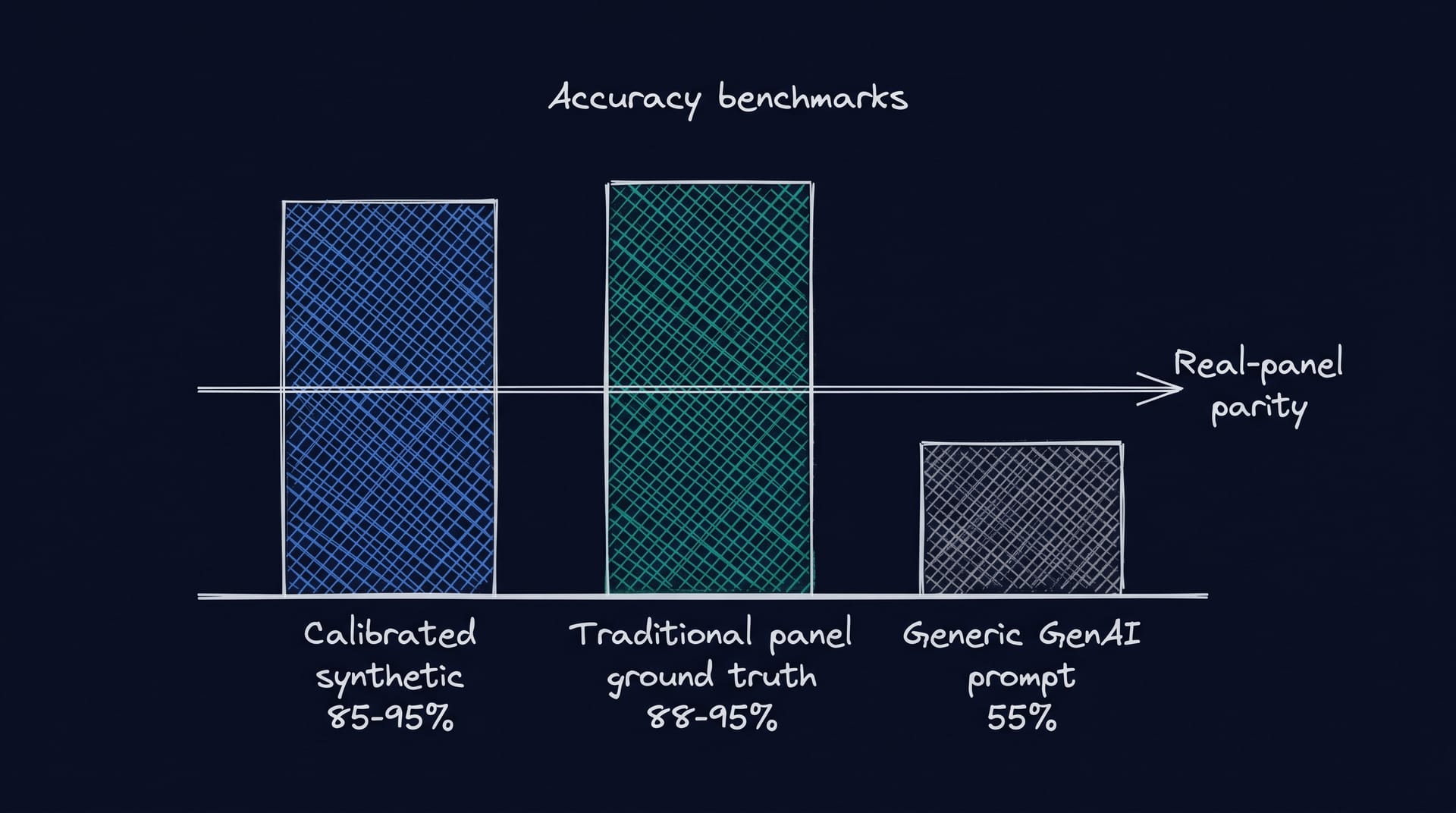
The weaker evidence sits on three terrains. The first is generic, uncalibrated LLM prompting, which sits around 55 percent parity and collapses to 37 to 60 percent on complex multi-step studies[3]. The second is open-ended emotional response, where models tend toward flat, agreeable, lowest-common-denominator answers[3]. The third is the simulation of marginalised or low-incidence populations, where peer-reviewed analyses show measurable stereotyping and reduced fidelity, with 80 percent of personas demonstrating implicit bias under certain conditions[15].
The picture is consistent. Calibrated synthetic respondents on closed-ended, mainstream work are research-grade. Generic LLM personas on emotional or edge-case work are not. The interesting part is that traditional methods are not perfect either: ARF’s non-probability panel work found average absolute errors of five to twelve percent on key questions, and BASES-style pre-launch forecasts carry ten to fifteen percent ranges before any AI is involved[6]. Synthetic respondents are not asked to beat a Platonic ideal of human panels. They are asked to be at least as good as the noisy, fatigued, expensive panels we actually have, on the questions we actually ask, and on those terms they are increasingly delivering.
Validation methodology: how to evaluate any synthetic panel claim
The acid test for any accuracy claim is whether you can interrogate the methodology behind it. The strongest commercial platforms have settled on a four-step validation pattern close to the one Qualtrics publishes: generalisation, data shape, diversity, and transferability[16]. Other vendors run Bayesian validation that produces explicit confidence intervals around synthetic insights[16]. For a deeper unpacking of which metrics actually matter, our companion piece on evaluation metrics for synthetic respondents walks through the specific statistical reliability checks worth demanding.
The practical rubric for a buyer is short. Ask for a head-to-head validation study against a fresh human panel on a category close to yours. Ask for question-level accuracy at the distributional level, not just aggregate means. Ask for the recipe of the underlying training corpus, with size, recency, and whether it is first-party or third-party. Ask how often the model is recalibrated against fresh ground truth. Ask whether the platform publishes its failure modes, because every honest vendor has them. Compare those answers with the rigour the same vendor would be required to show under the EU AI Act’s Annex III obligations and the GDPR’s Data Protection Impact Assessment framework, both of which apply once personal data anchors the model[17]. Vendors that flinch at this checklist are quietly telling you something useful.
Where AI Digital Twins outperform traditional methods
The four areas where synthetic respondents are decisively ahead are speed, scale, longitudinal consistency, and reach into hard-to-survey segments[13].
The speed gap is the most quantifiable. Bain reports synthetic-augmented work landing directional insights in half the time and one third of the cost of traditional studies[13]. A calibrated platform answers a concept test in hours rather than the four to eight weeks a traditional study requires, turning insights from a quarterly artefact into a daily input. That is why best-practice integrations now treat AI market research as a continuous utility rather than a project[18].
The scale gap matters when budget is the binding constraint. A synthetic platform can run thirty concept variants for the cost of a single traditional test. Marginal concepts that would never have been tested in the old economics now get a screening pass, and only the survivors are escalated to human validation.
The longitudinal gap is the most underrated. Real panels suffer from membership churn, panel conditioning, and seasonal noise. A digital twin calibrated on a stable corpus produces consistent baselines week after week, which is what brand and category tracking actually needs. Kantar itself, one of the most cautious voices in the industry, is now building synthetic data boosting at scale specifically for Brand Guidance tracking programmes[8].
The reach gap is the quiet one. Low-incidence segments such as specialist physicians or ultra-high-net-worth investors are notoriously expensive to recruit. Synthetic respondents calibrated on the relevant first-party data can model these segments at a fraction of the cost, with the caveat that bias risks rise as the training data thins, which is why the smart pattern is synthetic for screening plus a small targeted human top-up.
Where traditional methods still win
Honesty is part of the trust contract. Deep qualitative work, where the goal is to surface unarticulated feeling, conflict, or category-shifting language, is still better served by a skilled human moderator with real respondents, because LLMs systematically smooth toward agreeable answers[3]. Ground-truth calibration of any new synthetic platform requires fresh human data, otherwise the model has nothing to anchor against. Regulatory and litigation contexts, including pharmaceutical claim substantiation and trademark dilution evidence, still expect human respondents because legal precedent has not caught up. And edge populations where the training corpus is thin, including under-served minorities, niche medical conditions, or hyper-local cultural contexts, are at higher risk of the bias amplification documented in our dedicated bias analysis.
The mature pattern is therefore not synthetic versus traditional but synthetic plus traditional, with traditional anchoring the calibration layer and synthetic amplifying everything that sits on top of it. As Kantar’s Jane Ostler put it, synthetic data is an extension of human data, not a replacement[8].
The bias and limitations debate
The bias question is real and worth treating with the same seriousness as the accuracy question, because the two interact. Persona prompting strategies can amplify stereotyping when traits combine in ways that are unlikely in real survey data[15]. Implicit bias against socio-demographic groups has been documented in 80 percent of persona configurations under certain LLM settings, with measurable performance drops on simulated marginalised populations[19]. Sampling and non-response bias, the two original sins of survey research, are not automatically corrected by switching to synthetic respondents and can be inherited from the training corpus itself.
The countermeasures are the same ones that earned online panels their credibility two decades ago: transparent reporting of failure modes, explicit confidence intervals, calibration against probability benchmarks, and a willingness to leave certain populations to traditional methods. Our deep dive into the limitations of synthetic market research lays out the specific failure modes worth tracking. The point is not that synthetic respondents are uniquely flawed. It is that they should be held to the same standards as the methods they are increasingly replacing.
Ethics, privacy, and the EU AI Act angle
Accuracy and compliance are not separate concerns in 2026. Under the EU AI Act’s Annex III obligations that take effect from 2 August 2026, any AI system used for high-stakes decisions involving personal data triggers both a Fundamental Rights Impact Assessment under Article 27 and a Data Protection Impact Assessment under GDPR Article 35[17]. Synthetic respondents calibrated on real personal data sit cleanly inside this regime, which is a feature rather than a bug: properly anonymised synthetic data lets organisations run research without further personal-data collection[8].
The practical questions to ask of any vendor cover lawful basis for the underlying training data, the path to anonymisation, the auditability of the model, the documented bias-mitigation steps, and the alignment with both the AI Act and GDPR. Our companion article on ethics and privacy in AI market research maps the full compliance checklist. The short version is that calibrated synthetic respondents, run properly, are easier to defend on a privacy basis than recurring fresh human surveys.
A practical rubric for choosing the right method
If you take one decision aid from this guide, take this one. The choice between AI digital twins and traditional methods is not a religious commitment. It is a question-by-question call based on six dimensions: question type, decision stakes, population accessibility, speed requirement, budget, and regulatory context.
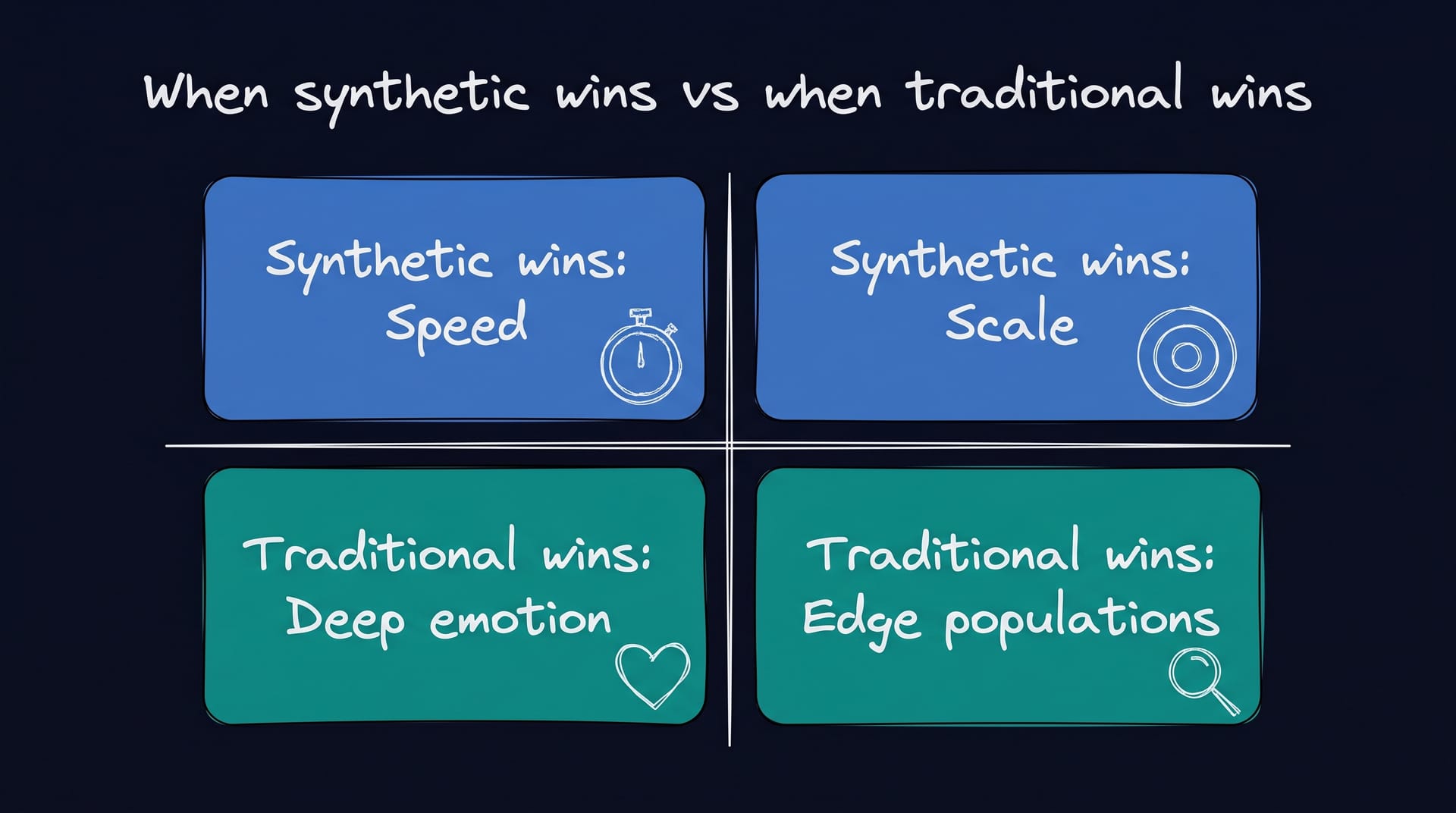
Use a calibrated AI digital twin when the question is quantitative or closed-ended, the population is mainstream and well represented in the training corpus, the decision is reversible or intermediate, speed matters, and budget is constrained. Use a traditional method when the question requires deep emotional texture, the population is edge or under-represented, the decision is high-stakes and irreversible, the legal context expects human respondents, or the answer will anchor calibration for a future synthetic system. Use both, in sequence, for everything else: synthetic to screen a large concept space cheaply, traditional to confirm the top candidates. The hybrid pattern sits at the heart of the broader debate about digital twins in market research.
Stress-test your next study against real-panel parity with neuroflash
neuroflash turns the accuracy question from a debate into a checklist. Run your next concept test, claim screen, pricing study, or segmentation pass against synthetic respondents calibrated to 85 to 95 percent panel parity, validated by 80+ academic studies, and grounded in over one million real European consumer profiles, and get a defensible answer with confidence intervals in hours rather than four to eight weeks. Pressure-test thirty variants for the cost of one traditional test, ship the survivors to a small human top-up for confirmation, and keep the same workspace open for the brand, copy, and campaign work that turns the answer into a launch. Start free today and see whether the parity number holds on your category, your audience, and your decision.

FAQ
Are AI digital twins really as accurate as traditional surveys?
For calibrated platforms on closed-ended quantitative questions covering mainstream populations, the published benchmarks place synthetic respondents at 85 to 95 percent parity with real human panels, which is inside the same error band traditional online panels carry against probability benchmarks[4][6]. For generic LLM prompts on emotional or open-ended questions, accuracy drops to around 55 percent and can crash on complex studies, which is why the methodology behind any accuracy claim matters more than the headline number[3].
How is synthetic respondent accuracy measured against human panels?
The credible studies use head-to-head validation against fresh human samples, with question-level distributional comparison rather than just aggregate means. The Stanford and Google DeepMind benchmark recruited 1,052 demographically representative U.S. participants, ran them through both the General Social Survey and behavioural economics games, and then asked the digital twins to predict the same answers, scoring at 85 percent normalised accuracy against the test-retest reliability of the humans themselves[4].
What is the accuracy of AI-generated consumer panels versus generic ChatGPT prompts?
Calibrated synthetic respondents built on real survey and behavioural data sit at 85 to 95 percent parity with real panels, while a generic ChatGPT-style “act as a German millennial” prompt sits closer to 55 percent and shows significant implicit bias under measurement[3][19]. The gap is the calibration chain: training corpus quality, embedding alignment, behavioural grounding, multi-respondent simulation, and continuous validation.
When do traditional surveys still outperform digital twins?
Traditional surveys remain the better answer for deep qualitative emotional work, ground-truth calibration of any synthetic platform, regulated contexts such as pharmaceutical claim substantiation, and edge populations where the synthetic training corpus is genuinely thin[3][15]. The most accuracy-minded research teams use traditional studies to anchor and confirm, and synthetic to scale and screen.
What validation methods should I demand from a synthetic respondent vendor?
Ask for a head-to-head validation study against a fresh human panel on a category close to yours, question-level distributional accuracy, full disclosure of the training corpus recipe, the recalibration cadence, the published failure modes, and explicit confidence intervals around any reported number[16]. Vendors that flinch at this checklist are quietly telling you something useful.
How representative are synthetic consumer panels of niche or minority groups?
Representativeness drops with the thinness of the underlying training data, and peer-reviewed work has shown measurable bias amplification when LLM personas simulate marginalised groups[15][19]. The robust pattern for edge populations is synthetic screening combined with a small targeted human confirmation sample, rather than synthetic alone.
Are synthetic respondents EU AI Act and GDPR compliant?
Calibrated synthetic respondents based on real personal data fall inside both the EU AI Act regime that takes effect from 2 August 2026 and the GDPR. Compliant deployment requires a Fundamental Rights Impact Assessment under Article 27 of the AI Act, a Data Protection Impact Assessment under Article 35 of the GDPR, documented bias-mitigation steps, and clear auditability[17]. Properly anonymised synthetic data can actually strengthen the privacy case for research because it reduces the need for further personal-data collection.
What is the realistic 2026 accuracy outlook for synthetic respondents?
Rival Group’s 2026 Market Research Trends report and Kantar’s roadmap converge: training corpora are getting richer, validation studies are multiplying, and the parity gap is closing on closed-ended work while qualitative depth is the live frontier[5][8]. Buyers should expect 90 percent plus parity to become standard for calibrated quantitative studies during 2026.
My Take
The accuracy debate has moved past the point where dismissing AI digital twins is a sign of methodological seriousness. The Stanford and Google DeepMind benchmark, ARF’s non-probability work, Kantar’s roadmap, and the GRIT data on response-rate collapse all point the same way: the legacy method is under genuine pressure, and the calibrated synthetic alternative is no longer a toy. The best research teams I see are not picking sides. They are reorganising around a hybrid in which synthetic respondents do the cheap, fast, large-scale screening and human panels do the calibration and the deep emotional work. The teams stuck arguing about which method is “more accurate” in the abstract are usually the ones waiting four to eight weeks for answers their competitors get in an afternoon. The accuracy question is real, and the answer is increasingly that calibrated synthetic respondents are research-grade for most of the questions most teams actually ask.
References
[1] Gartner (2025): “AI-driven customer simulations and synthetic personas in product marketing.” https://www.gartner.com/en/documents/5451563
[2] Altair Media (2026): “Synthetic Audiences: The Future of Market Research, Hype, Reality and Outlook for 2026.” https://altair-media.com/posts/synthetic-audiences-in-market-research-hype-reality-and-outlook-for-2026
[3] CleverX (2026): “Synthetic Respondents vs Real Participants: When to Use Which in 2026.” https://cleverx.com/guides/synthetic-respondents-vs-real-participants-when-to-use-which-in-2026/
[4] Stanford HAI and Google DeepMind (2024): “Generative Agent Simulations of 1,052 Individuals.” https://hai.stanford.edu/news/ai-agents-simulate-1052-individuals-personalities-with-impressive-accuracy
[5] Rival Group (2026): “2026 Market Research Trends Report.” https://www.rivaltech.com/rival-group-market-research-trends-2026
[6] Advertising Research Foundation (2014): “Assessing the Accuracy of 51 Non-Probability Online Panels and River Samples: ARF Foundations of Quality 2.” https://research.google/pubs/assessing-the-accuracy-of-51-nonprobability-online-panels-and-river-samples-a-study-of-the-advertising-research-foundation-2013-online-panel-comparison-experiment/
[7] KL Communications (2025): “Why Survey Response Rates Are Suddenly Plummeting.” https://www.klcommunications.com/why-survey-response-rates-are-suddenly-plummeting-the-2025-email-deliverability-crisis/
[8] Kantar (2025): “Synthetic Data: The Real Deal? Opportunities and challenges for market research.” https://www.kantar.com/inspiration/ai/synthetic-data-the-real-deal
[9] GreenBook (2025): “Testing Synthetic Data Against Academic Benchmarks: A Replication Study.” https://www.greenbook.org/insights/data-science/testing-synthetic-data-against-academic-benchmarks-a-replication-study
[10] ESOMAR (2025): “Global Market Research 2025.” https://esomar.org/publications/global-market-research-2025
[11] McKinsey & Company (2025): “The state of AI: Agents, innovation, and transformation.” https://www.mckinsey.com/capabilities/quantumblack/our-insights/the-state-of-ai
[12] Quirks (2025): “The shelf life of an AI synthetic panel.” https://www.quirks.com/articles/the-shelf-life-of-an-ai-synthetic-panel
[13] Bain & Company (2025): “Synthetic Customers Earn Their Stripes.” https://www.bain.com/insights/synthetic-customers-earn-their-stripes/
[14] Ipsos (2025): “The Power of Product Testing with Synthetic Data.” https://www.ipsos.com/en-us/humanizing-ai-2-the-power-of-product-testing-with-synthetic-data
[15] ScienceDirect (2025): “Bias and gendering in LLM-generated synthetic personas from a participatory design perspective.” https://www.sciencedirect.com/science/article/pii/S1071581925002083
[16] Qualtrics (2025): “Synthetic Data for Market Research FAQ.” https://www.qualtrics.com/articles/strategy-research/synthetic-data-market-research/
[17] Latham & Watkins (2025): “EU AI Act Update: Compliance Timeline and Synthetic Data Considerations.” https://www.lw.com/en/insights/ai-act-update-eu-resolves-to-change-rules-and-extend-deadlines
[18] MIT Sloan (2024): “New research suggests AI is more likely to complement, not replace, human workers.” https://mitsloan.mit.edu/press/new-mit-sloan-research-suggests-ai-more-likely-to-complement-not-replace-human-workers
[19] arXiv (2023): “Bias Runs Deep: Implicit Reasoning Biases in Persona-Assigned LLMs.” https://arxiv.org/abs/2311.04892