
Generative engine optimization, or GEO, is the practice of structuring and evidencing content so that generative AI systems such as ChatGPT, Perplexity and Google AI Overviews cite it directly inside their answers. The term did not originate with an SEO vendor. It comes from a controlled academic study, and that origin is the strongest reason to take it seriously. For a business, GEO now decides whether a brand appears at all in the moment a buyer asks an AI for a recommendation.
Key Takeaways
- GEO optimizes content to be cited inside a generative engine’s answer, not to rank in a list of links. The research behind the term comes from Princeton, not a marketing agency.[1]
- A controlled Princeton study measured a visibility lift of up to 40% from specific content changes, an experimental result, not a guarantee for every brand.[1]
- Traditional search volume is projected to fall 25% by 2026 as users shift to AI chatbots, according to Gartner.[2]
- ChatGPT alone now serves more than 900 million weekly active users, so the channel is no longer a rounding error.[3]
- McKinsey finds that 50% of consumers already use AI powered search, with 750 billion USD in spending flowing through it by 2028.[4]
What generative engine optimization means
GEO is the discipline of preparing content so that a generative AI system selects it as a source and repeats its claims, numbers or framing inside a synthesized answer. The unit of success is a citation, not a blue link on page one.
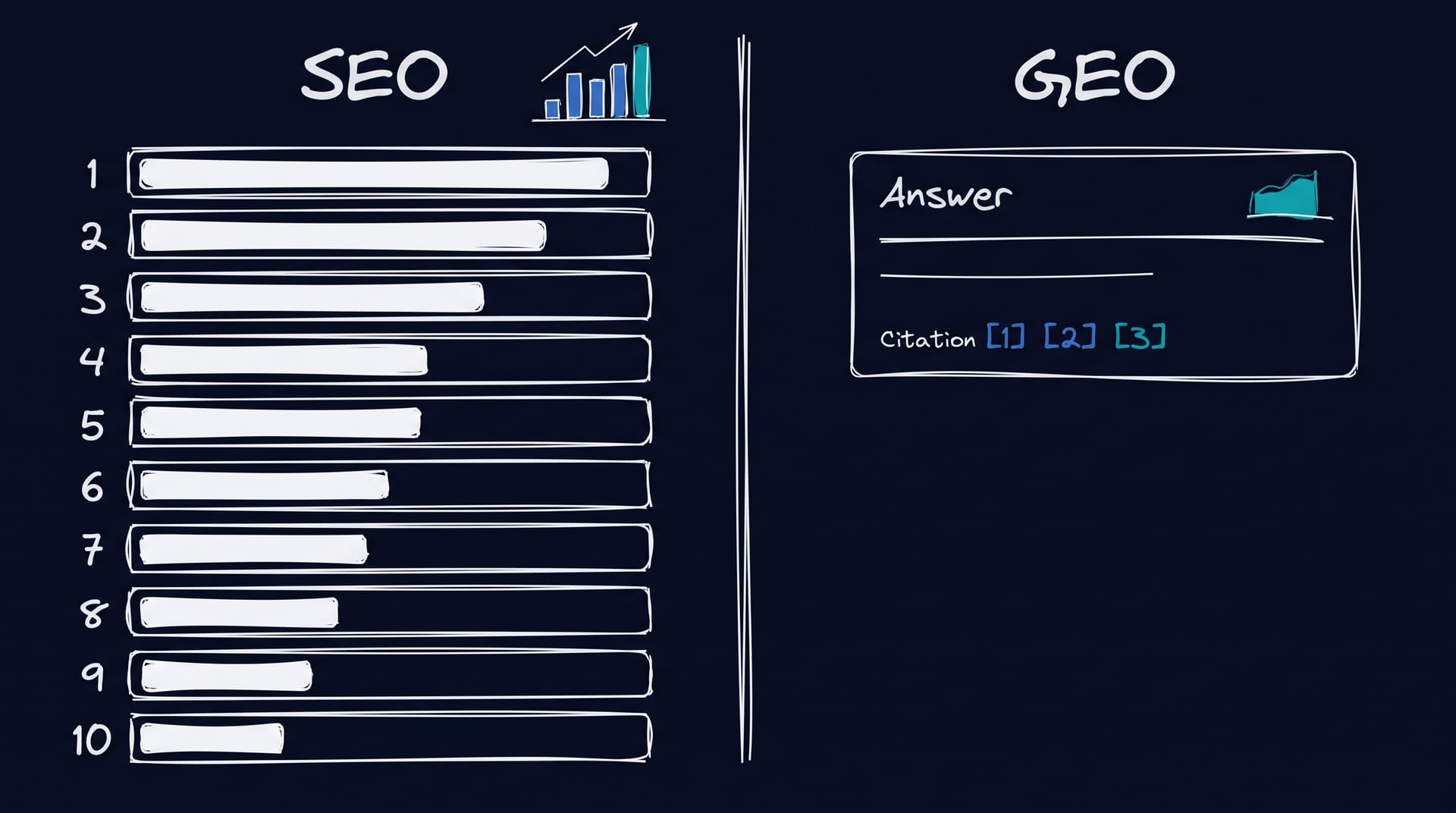
A traditional search engine returns a ranked list and lets the user pick. A generative engine reads across many sources, decides which claims to trust, and writes one answer. Being the tenth link on a results page still gets an occasional click. Being the tenth source a generative engine considered and did not cite gets nothing, because there is no list left to scroll through.
Content that gets pulled into these answers shares a few traits: it states claims with specific numbers, attributes them to a named source, and is structured clearly enough for a system extracting a fact to find it without wading through narrative. That is close to what the founding research on this topic tested, covered next.
Where the term comes from: the Princeton research
GEO is one of the few marketing terms with a real academic paper behind it. A research team led by Aggarwal and colleagues at Princeton University published “GEO: Generative Engine Optimization,” accepted at ACM SIGKDD 2024, and it is the closest thing this field has to a founding document.[1]
Here is what the researchers did. They took real user queries, ran them through generative search systems, and applied content interventions to the source pages: adding statistics, adding quotations from credible sources, citing sources explicitly, and improving clarity. They then measured whether the modified page was cited more often, and how prominently, using a metric built for visibility inside a generated answer.[1] The headline result: interventions such as statistics and clearly attributed quotations increased a source’s visibility in generative answers by up to 40% relative to the unmodified baseline.[1]
What that figure proves is narrower than most summaries suggest. It shows specific, testable content changes produced a measurable, repeatable increase in citation likelihood, on the systems tested at the time. It does not prove every brand will see a 40% lift, or that the interventions work identically across ChatGPT, Perplexity and Google AI Overviews. Generative systems have changed since the study ran, and the paper frames the number as an average, not a floor.
What still holds is the mechanism: generative engines can be influenced by how a source presents evidence, and that influence is measurable rather than anecdotal. That is why GEO graduated from a buzzword to a legitimate strategic category.
How generative engines differ from search engines
The mechanical difference is retrieval and synthesis instead of a ranked index. A search engine crawls, indexes and ranks pages, then hands the list to the user. A generative engine retrieves candidate sources, reads them, and synthesizes one prose answer, deciding which claims to keep and which sources to name.
That changes what a click is worth. Ahrefs found top ranking pages lose 34.5% of their clickthrough rate once an AI Overview appears above them.[5] Yet the traffic that does arrive behaves differently: ChatGPT referral traffic accounts for only about 0.5% of visits on the sites Ahrefs studied, yet generates roughly 12.1% of signups, since the visitor already had the AI’s recommendation before clicking through.[6]
The zero click pattern is not limited to AI Overviews. SparkToro found 68.01% of Google searches in the US now end without a click, up from 60.45% in 2024.[7] Forrester estimates buyers using an AI system instead of a search engine are only one tenth as likely to click through at all.[8] One answer replaces ten links, and citation replaces position as the currency that matters.
GEO next to SEO, AEO and LLM SEO
GEO sits alongside a small cluster of adjacent terms, and mixing them up wastes strategy time.
| Term | What it emphasizes | Where we cover it |
|---|---|---|
| GEO | The definition, the research grounding, and the structural shift from ranking to citation | This article |
| SEO | Ranking in a results list, keyword targeting and how to split budget against GEO | GEO vs SEO |
| AEO | How answer engines and featured snippets select and format a single quoted answer | Answer engine optimization |
| LLM SEO | The technical mechanics: crawling, embeddings, retrieval and structured data for language models | LLM SEO |
A fifth term, GAIO, circulates in some markets, but it has gained essentially no traction in English language marketing discourse. We recommend avoiding it in English content and using GEO as the umbrella term instead. These terms persist side by side partly because engines disagree on what to cite: BrightEdge measured the overlap of top 100 citation sources between AI engines at only 16 to 59%.[9]
What actually moves the needle
Five levers explain most of the variance between brands that get cited and brands that do not.
Evidence density is the first, and the one the Princeton research tested most directly: specific numbers attributed to a named source outperform generic claims, because a generative engine is effectively fact checking as it writes.
Structural clarity is the second. Clear headings, direct answers near the top of a section, and short scannable paragraphs make it easier for a retrieval system to extract a clean claim.
Freshness and update cadence is the third. Only 30% of brands stay visible across back to back answers, and pages unrefreshed for a quarter are three times more likely to lose citations.[10]
Multi engine coverage is the fourth. With citation source overlap between engines as low as 16%, optimizing for a single engine leaves most of the opportunity uncovered.[9]
Third party corroboration is the fifth. ChatGPT and Gemini share only 4.9% of cited sources for identical queries, so being mentioned on other credible sites, not only a brand’s own domain, widens the chance of being cited.[11]
These levers explain direction, not the full execution. For the complete engine by engine checklist, see the AI Visibility 2026 guide.
What a GEO programme looks like in practice
A working GEO programme needs three roles, though rarely three separate people at a small or mid sized company: a content owner who rewrites priority pages around evidence and clarity, a monitoring owner who tracks whether the brand appears across engines, and a budget owner who prioritizes GEO against classic SEO and paid channels.
The first 90 days follow a predictable shape. Weeks one and two audit: list the 15 to 20 questions the audience most plausibly asks an AI system, and check citation status across two engines. Weeks three through six rewrite the highest value pages with named sources and clearer structure. Weeks seven through ten extend that treatment to secondary topics. Weeks eleven through thirteen set the recurring cadence, since unrefreshed pages are three times more likely to lose citations after a quarter.[10] The AI Visibility 2026 guide covers the fuller operational playbook, including channel specific tactics.
Measuring GEO
Four metrics replace the old ranking report: citation share, how often a brand is cited for target questions relative to competitors; share of voice, the brand’s proportion of all mentions across a topic and multiple engines; sentiment, whether the citation is favorable, neutral or critical, since being cited is not the same as being recommended; and referral traffic from AI sources, the smallest number but, per the Ahrefs signup data cited earlier, often the most valuable per visit.[6]
Similarweb’s data shows a real trend line: brand citations in ChatGPT rose from 0.6% in January 2025 to 2.8% in August 2025, a shift that only shows up when measured repeatedly over months.[12]
Here is the part most vendors skip. Generative answers vary between runs and near identical phrasings of the same question. Wellows found ChatGPT and Gemini share only 4.9% of cited sources for the same query, evidence of how much variance exists even holding the question constant.[11] A single manual check in ChatGPT proves close to nothing. What holds up is sampling: the same questions, asked repeatedly, across engines, tracked over weeks.
Why keyword data cannot capture what people actually ask an AI
Most GEO efforts start with the wrong input. A keyword tool shows a short, compressed query like “geo marketing tools,” stripped of context. Inside an actual AI conversation, the same person types a full situation: industry, team size, budget ceiling, the competitor already ruled out, and the specific worry stopping them from deciding. A page optimized only for the three word keyword can miss the real question, because the real question was never three words long.
This is the gap neuroflash Digital Twins are built to close. Built on real human profiles that can be queried directly, they let a team ask the questions a full research cycle would normally take: how would this audience research this decision, which exact prompt would they type first, which follow up question comes next, which criteria decide between two similar options.
From there, the content work follows. Automated workflows write new articles that are AI optimized from the first draft, and rework existing articles already published on a site so answer engines can parse the claims and cite them, instead of leaving an older content library behind while only new pages get the treatment. More on the platform is at neuroflash.
- More than 1,000,000 real human profiles, queryable directly for the exact prompts and follow up questions a target audience uses
- 85 to 98% predictive accuracy versus around 55% for generic AI tools, validated across more than 80 academic studies
- Results in minutes instead of the 4 to 8 weeks a classic survey requires
- Automated workflows for both new articles and for reworking an existing content library so it becomes citable

FAQ
What does GEO stand for?
GEO stands for generative engine optimization: structuring and evidencing content so generative AI systems cite it inside their answers rather than only ranking it in a list of links.
Is GEO the same as SEO?
No. SEO optimizes for a position in a ranked results list, while GEO optimizes for being cited inside an AI generated answer. The metrics and content requirements differ meaningfully, covered in full in the GEO vs SEO comparison.
Does the Princeton study prove GEO works for every brand?
No. The study showed that specific content interventions produced a measurable, repeatable increase in citation likelihood, with an average lift of up to 40% on the systems tested at the time. That is evidence the mechanism works, not a guaranteed outcome for any individual brand or model version.
How is GEO different from AEO?
AEO, answer engine optimization, is the older term and focuses on how answer engines and featured snippets select and format a single quoted answer. GEO is the broader term for generative engines generally, and in practice the two overlap heavily.
How long does it take to see GEO results?
Individual pages can show citation changes within a few weeks of a rewrite, but a defensible trend needs repeated measurement over months, because generative answers vary between runs and between engines for the same query.
My Take
The Princeton research is the reason GEO deserves a strategy and a budget rather than a blog post’s worth of curiosity. A peer reviewed, controlled study showing a measurable citation lift from specific, repeatable content changes is a different category of evidence than the usual marketing claim.
That said, precision matters more than enthusiasm. The 40% figure is an average from one study, on the systems available in 2024, and citation behavior across ChatGPT, Perplexity and Google AI Overviews has moved since then. Treating that number as a fixed multiplier for any project is a mistake worth naming directly.
What holds up regardless of the exact figure is the direction: evidence dense, clearly structured, regularly refreshed content gets cited more, across every engine studied so far. Teams that build a real measurement habit around citation share, instead of checking ChatGPT once and calling it done, will be able to tell in six months whether their GEO work actually moved anything.
References
[1] Princeton, Aggarwal et al. (2024): “GEO can boost visibility in generative engine responses by up to 40%. Paper accepted at ACM SIGKDD 2024.” https://arxiv.org/abs/2311.09735
[2] Gartner (2024): “Traditional search engine volume will drop 25% by 2026 as users move to AI chatbots.” https://www.gartner.com/en/newsroom/press-releases/2024-02-19-gartner-predicts-search-engine-volume-will-drop-25-percent-by-2026-due-to-ai-chatbots-and-other-virtual-agents
[3] Search Engine Land (2026): “ChatGPT has more than 900 million weekly active users.” https://searchengineland.com/chatgpt-900-million-weekly-active-users-470492
[4] McKinsey (2026): “50% of consumers already use AI powered search and 750 billion USD in spending will flow through it by 2028.” https://www.mckinsey.com/capabilities/growth-marketing-and-sales/our-insights/new-front-door-to-the-internet-winning-in-the-age-of-ai-search
[5] Ahrefs (2025): “Top ranking pages lose 34.5% of their clickthrough rate when an AI Overview is present.” https://ahrefs.com/blog/ai-overviews-reduce-clicks/
[6] Ahrefs (2025): “ChatGPT traffic accounts for about 0.5% of visits but generates about 12.1% of signups.” https://ahrefs.com/blog/chat-gpt-traffic
[7] SparkToro (2026): “68.01% of Google searches in the US end without a click, up from 60.45% in 2024.” https://sparktoro.com/blog/in-2026-less-than-one-third-of-google-searches-still-send-a-click/
[8] Forrester (2026): “Buyers using AI instead of search are one tenth as likely to click through to your website.” https://www.forrester.com/blogs/zero-click-is-only-half-the-ai-story/
[9] BrightEdge (2026): “The overlap of top 100 citation sources between AI engines is only 16 to 59%.” https://www.brightedge.com/resources/weekly-ai-search-insights/ai-search-same-brands-different-sources
[10] AirOps (2026): “Only 30% of brands stay visible across back to back answers, and pages not updated quarterly are three times more likely to lose citations.” https://www.airops.com/report/the-2026-state-of-ai-search
[11] Wellows (2026): “Across 11.1 million citations in 571,729 AI answers, ChatGPT and Gemini shared only 4.9% of cited sources for identical queries.” https://wellows.com/blog/llm-seo/
[12] Similarweb (2026): “Brand citations in ChatGPT rose from 0.6% in January 2025 to 2.8% in August 2025.” https://www.similarweb.com/blog/marketing/geo/gen-ai-stats/