An MCP connection means your AI agent no longer just writes text, it taps into real tools and data sources. That is exactly what the new neuroflash API and MCP Server makes possible. Using Digital Twins via API and MCP means you keep generating your content in Copilot, Claude, ChatGPT or Langdock, but you can now test it against a real audience in the same window, before it goes live[1]. At launch, timed with the Product Hunt debut, your agent turns into a complete loop of creating and validating. This article explains, in plain language, what that means in practice for marketing teams, with no code involved.
TL;DR
- neuroflash is not another LLM tool, it is the audience-research layer your AI agents tap into via API and MCP[1]
- New: you can generate content and test it against calibrated Digital Twins right away, straight from your agent[1]
- The Digital Twins are built on more than 1,000,000 real survey profiles and match human answers with 85 to 95 percent parity against real panels[2]
- Subject lines, ad copy and claims get checked in minutes instead of weeks of fieldwork[3]
- GDPR-compliant, hosted in Germany, ISO 27001 certified, with no stored API keys thanks to browser login[1]
What does API and MCP access mean in practice for marketing?
Using Digital Twins via API and MCP means neuroflash’s calibrated audience sits right inside your AI agent. You no longer switch between tools. Your agent generates a piece of copy and, in the next step, asks a real, data-based audience how they react. The result comes back in minutes, not weeks. For insights and brand teams, that means more tested decisions on the same time budget[1].
Two terms keep coming up, and both can be explained without any tech. An API is a standardized interface that lets two programs talk to each other. Instead of a person clicking buttons, one piece of software queries another directly and gets structured answers back. MCP stands for Model Context Protocol. It is the open standard that AI agents like Claude or Copilot use to connect external tools and data sources. Think of MCP as a universal plug: once it is connected, your agent can use the Digital Twins without you installing or coding anything[1].
The neuroflash server runs as a remote service. You log in once through the browser, no keys are stored on your machine, and your usage draws from the same quota as the web app. There is no hidden second bill[1].
Why is neuroflash a research layer, not an LLM tool?
A large language model produces plausible-sounding answers from training data. But it does not know how a specific audience really thinks. neuroflash Digital Twins are built for exactly that: they are based on more than a million real survey profiles with up to 255 data points per person, and they reproduce real opinions instead of inventing them[2]. That is why neuroflash is the layer beneath your agent, not a replacement for it.
The difference is measurable. Generic LLM prompts only roughly approximate how real people react. The calibrated Digital Twins, by contrast, reach 85 to 95 percent parity against real survey panels[2]. For a campaign decision, that is the difference between a guessed opinion and a signal you can rely on.
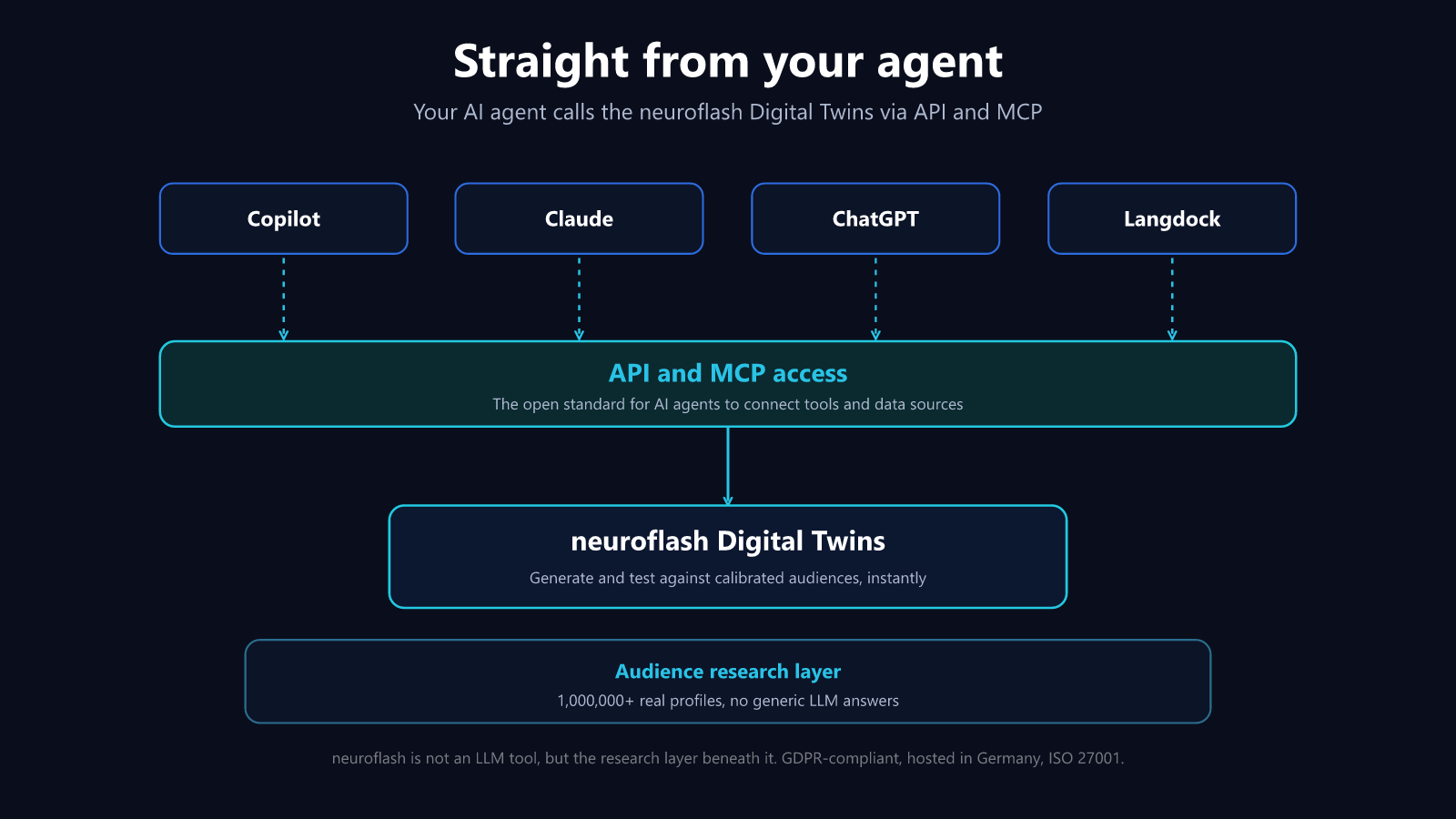
The graphic shows the principle: at the top are the AI agents you already use. In the middle sits API and MCP access as an open standard. Beneath it are the Digital Twins and the research layer with the real profiles. Your agent stays your agent, but gains a reliable data source.
How does the create-and-validate loop work inside the agent?
The heart of the launch is a continuous loop in a single window. You ask your agent to write an on-brand piece of copy. In the next step, you have that copy tested against the right Digital Twins. You get feedback in minutes, refine the copy and publish it with far more confidence. No tool switching, no waiting room for field research[1].
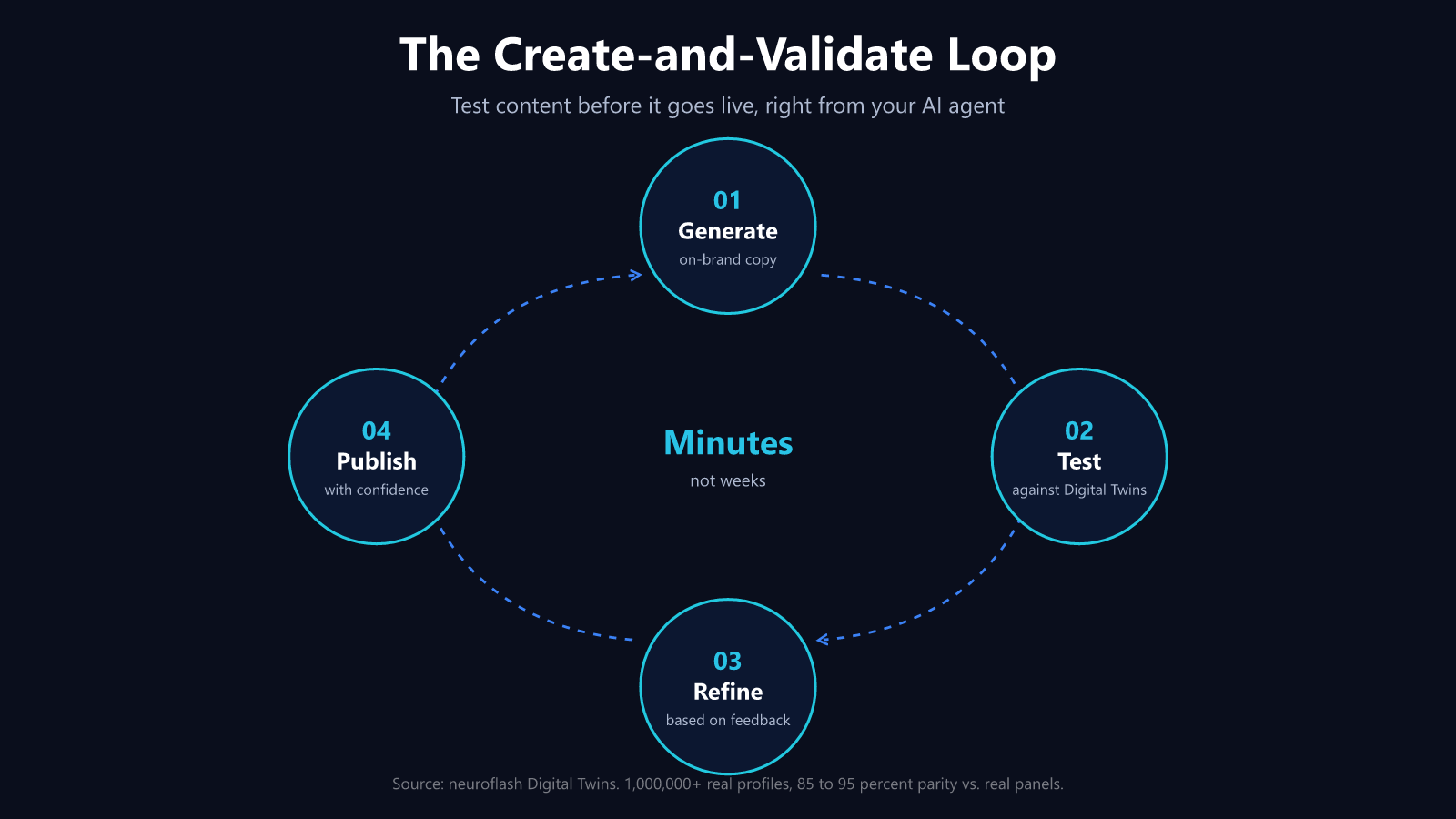
Here is what it looks like day to day. You have five subject lines for a newsletter. Instead of sending them out blind, you ask your agent which variant your audience is most likely to open, and you get a reasoned ranking back. In the same way, you can pit ad copy against each other or check a new product claim against a calibrated audience before launch. What used to need a week of panel lead time now happens between two prompts[3].
For teams, this shifts the order of things. Testing is no longer the expensive step at the end that often gets dropped for lack of time, but a normal in-between step while writing. The table below compares the two ways of working.
| Content process | Without testing in the agent | With testing in the agent |
|---|---|---|
| Where testing happens | separate panel, or not at all | right in the agent, next to the copy |
| Time to feedback | days to weeks[3] | minutes[3] |
| Data basis | generic LLM guess or expensive fieldwork | more than 1,000,000 real profiles[2] |
| Reliability | hard to gauge | 85 to 95 percent parity vs. real panels[2] |
| Variants per week | few, because testing is costly | many, because testing runs alongside |
What does this mean for insights and brand managers, concretely?
For insights teams, the barrier to testing at all drops. Small questions that never justified a panel budget can now be answered: the tone of a claim, the order of arguments, the effect of an image concept in the copy. Brand managers, in turn, get an early-warning system before a message goes out[1].
Important for legal and data protection: the Digital Twins work with synthetic profiles, not with personal data of individual users. The service is GDPR-compliant, hosted in Germany and certified to ISO 27001. That makes it defensible even in regulated industries and for sensitive campaigns[1]. If you want the technical perspective and the documentation, you will find the developer view in the technical sister article on the neuroflash API and MCP Server.
Get started
Want to try it right away? Here is how you bring the Digital Twins into your AI agent: authorize the server URL once in the browser and let your agent ask. The resources below give you the overview and the concrete steps, no coding required.
- The neuroflash API at a glance
- The neuroflash MCP Server at a glance
- API documentation
- Set up the MCP Server
For the technical perspective and the developer view, see the technical sister article on the neuroflash API and MCP Server.
FAQ
What is an MCP connection, in simple terms?
MCP stands for Model Context Protocol, the open standard that AI agents use to connect external tools and data sources. An MCP connection to neuroflash means your agent can use the Digital Twins like a built-in tool, without you installing or coding anything[1].
Do I need coding skills to use Digital Twins via API and MCP?
No. Through MCP you talk to your agent in plain language, and the agent handles the query in the background. You log in once through the browser, and no keys are stored on your machine[1].
How reliable are the Digital Twins’ results?
The Digital Twins are based on more than 1,000,000 real survey profiles and reach 85 to 95 percent parity against real panels. That is far closer to reality than a generic LLM guess[2].
What can I test before a launch?
Typical use cases are newsletter subject lines, ad copy and new product claims. You pit variants against each other and get a reasoned read from your audience back in minutes[3].
Is this data-protection compliant for campaigns in Germany?
Yes. The Digital Twins work with synthetic profiles rather than personal user data. The service is GDPR-compliant, hosted in Germany and certified to ISO 27001[1].
Conclusion
For me, the most exciting part of this launch is not the technology but the new habit it enables. When testing is no longer a project but an in-between step while writing, teams simply test more often. That is exactly where better campaigns come from: not from a bigger model, but from more tested decisions. And the fact that neuroflash does not replace your LLM but gives your agent a real audience to work with is, to me, the more honest path. If you already work with Copilot, Claude or ChatGPT, the create-and-validate loop is worth a look.
References
[1] neuroflash (2026): “neuroflash API and MCP Server: generate and validate content.” https://neuroflash.synaps.media/api-mcp-launch-de/
[2] neuroflash (2026): “Digital Twins: more than a million real profiles and 85 to 95 percent parity.” https://neuroflash.com/en/
[3] neuroflash (2026): “Test subject lines, ads and claims in minutes instead of weeks.” https://neuroflash.synaps.media/api-mcp-launch-de/