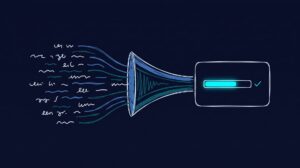
A programmatic market research API is an interface that lets your software run audience research automatically, without a person driving each query. Instead of logging in, setting up a study, and reading a report, your application sends a request describing the audience and the question, and gets a structured answer back in seconds. The word programmatic is the key: research stops being a task someone schedules and becomes a service your systems call on their own, at whatever scale and frequency you need.
This article covers what programmatic means in a research context, what you can automate, and how to think about doing it well. It builds on the broader Synthetic Audience API pillar, which covers the fundamentals of querying grounded AI audiences.
What „Programmatic“ Actually Adds
A regular research platform is something a person operates. A programmatic API is something a system operates. That shift unlocks three things a manual workflow cannot match: scale, because you can run hundreds or thousands of queries without proportional human effort; speed, because a request returns in seconds instead of a fielding cycle; and integration, because the results can flow directly into the next automated step rather than a slide someone has to build.
The output is structured by design, so it is machine-readable. A programmatic call returns fields your code can act on, ranked preferences, percentages, sentiment, rather than prose a person has to interpret.
What this means for your team: the value is not just faster answers, it is answers your other tools can consume automatically. That is what turns audience feedback from a report into an input.
What You Can Automate
The strongest automations share a pattern: a repeated decision that currently waits on manual research.
- Creative and concept checks in a pipeline. Route every new ad variant or landing page angle through an audience check before a human reviews it, so weak ideas are filtered early. For the focused methodology, see Synthetic Audience Creative Testing API.
- Batch testing at scale. Run the same question across hundreds of products, segments, or markets in one job, something that is simply not economical with fielded panels.
- Scheduled tracking. Re-run a set of audience questions on a schedule to watch how sentiment or preference shifts over time.
- Feedback loops in your own apps. Feed audience scores into internal dashboards, prioritization tools, or content systems as an ambient signal.
What this means for your team: start with the one repeated research request your team files most often, and automate that first. For automating audience feedback across no-code platforms like n8n, Zapier, and Make specifically, see Context-as-a-Service.

A Concrete Example
Picture a performance team that ships dozens of ad variants a week. Manually, each one waits in a queue for a research check that may never happen, so most launch untested. With a programmatic market research API, the content system calls the API the moment a variant is created, sends the creative and the target segment, and gets back a predicted resonance score with reasoning. Variants below a threshold get flagged for revision, strong ones move to a live A/B test. No one opened a research tool, and the media budget now validates strong candidates instead of eliminating weak ones.
That only works if the answer is trustworthy, which comes back to what the API is grounded in. A grounded audience produces a score you can act on, an ungrounded one produces a guess dressed as a score[2].
What this means for your team: automation multiplies whatever is behind the API. If the data is grounded, you scale good decisions. If it is not, you scale noise.
Accuracy at Scale
Automating research does not lower the bar for accuracy, it raises it, because a bad signal now propagates automatically. The evidence on grounded synthetic audiences is encouraging where it counts: academic work shows demographic-conditioned models closely matching real opinion surveys on attitudinal questions[3], and Bain reported digital twins replicating about 90% of key outcomes from human research in a consumer technology case[2]. The honest caveat, from NIQ, is that a convincing answer is not automatically an accurate one, so synthetic output should supplement primary research when stakes are high[4].
What this means for your team: automate the attitudinal and preference questions where grounded synthetic audiences are strong, and keep a human validation step for the high-stakes, volatile calls. For the full comparison to fielding your own study, see Synthetic Respondents API vs. traditional survey tools.
How neuroflash Digital Twins Power Automated Research
Behind every automated call, the data is what matters. neuroflash Digital Twins are audience profiles built on more than 1,000,000 real human survey profiles, not a generic model improvising a persona. That grounding is what lets neuroflash reach 80 to 90% prediction accuracy on audience response testing, compared with roughly 55% for generic AI tools without real data behind them.
The principle is simple: we predict, we don’t guess. Every response traces back to real profile data, which gives teams Decision Security, the confidence to automate a check because it is grounded, not because it sounds plausible. Results come back in minutes, neuroflash is made in Germany, GDPR compliant, and hosted with EU data residency, and Digital Twins are reachable through the API, the app, and MCP.
Automate Your Research with the neuroflash API
neuroflash exposes its Digital Twins as an API your systems can call programmatically, so audience checks run automatically instead of waiting on a person. The fastest way to see it is to send one automated query and read the structured result.

FAQ
What is a programmatic market research API?
It is an interface that lets your software run audience research automatically, sending a question over the API and receiving structured results, so research runs without a person operating a platform for each query.
How is it different from using a research dashboard?
A dashboard is operated by a person for one study at a time. A programmatic API is operated by your systems, so you can run research at scale, on a schedule, or inside an automated workflow.
What should I automate first?
The single repeated research request your team files most often. Creative and concept pre-testing in a content pipeline is the most common high-value starting point.
Is automated synthetic research accurate enough to act on?
For attitudinal and preference questions grounded in real data, yes. neuroflash reaches 80 to 90% prediction accuracy on audience response testing. Keep a human validation step for volatile, high-stakes decisions.
Do I need engineering resources to use it?
Some, for a custom pipeline. For lighter automation you can connect through no-code platforms, and for natural-language use inside an assistant there is also an MCP route.
Bottom Line
A programmatic market research API is worth adopting for one reason: it removes the human bottleneck from a decision your team makes over and over. The gain is not a single faster answer, it is hundreds of them, running automatically, feeding straight into the next step. Ground it in real data, point it at the repeated attitudinal questions it handles well, and audience feedback stops being a report you wait for and becomes a signal your systems already have.
Sources
[1] Anthropic (2024): „Introducing the Model Context Protocol.“ https://www.anthropic.com/news/model-context-protocol
[2] Bain & Company (2025): „Synthetic Customers Earn Their Stripes.“ https://www.bain.com/insights/synthetic-customers-earn-their-stripes/
[3] Argyle, L.P., Busby, E.C., Fulda, N., Gubler, J.R., Rytting, C., Wingate, D. (2023): „Out of One, Many: Using Language Models to Simulate Human Samples.“ Political Analysis. https://arxiv.org/abs/2209.06899
[4] NIQ (2024): „The Rise of Synthetic Respondents in Market Research.“ https://nielseniq.com/global/en/insights/education/2024/the-rise-of-synthetic-respondents/
[5] The Alchemic (2026): „67 Market Research Statistics for 2026: AI, Growth & Trends.“ https://thealchemic.com/blog/market-research-statistics/
[6] Fairgen (2025): „The Promise of Synthetic Data in Market Research.“ https://www.fairgen.ai/blog/the-promise-of-synthetic-data-a-breakthrough-in-market-research-data-collection
[7] Fortune Business Insights (2026): „Synthetic Data Generation Market, Forecast Analysis.“ https://www.fortunebusinessinsights.com/synthetic-data-generation-market-108433